
Intro
Chelsea:
Hey everyone and welcome to the S.O.B. Marketing podcast. Where we celebrate to S.O.B. you are, and if you haven't figured it out yet - we mean Small Owned Business, we don't mean S.O.B...
Vivian:
Listen, we know that as a small business owner you are working hard on the daily to keep your business fully operational while trying to promote it. And while some days it may feel like the business is owning you, if we're being honest with each other I bet you would admit that you wouldn't give up the insanity for anything.
Chelsea:
Our commitment here at the S.O.B. Marketing podcast is to give you the real talk, what works when it comes to advertising, marketing, and promoting your business. And then what doesn't really work.
Vivian:
And Chelsea and I promise to always keep the conversation real.
Beginning of Episode
Chelsea:
Hey everybody and welcome back to the S.O.B. Marketing Podcast. S.O.B. as in Small Owned Business. We would never call you guys names. Real quick before we get started, if you're new here, we are starting a marketing cult. So make sure that you follow or subscribe so that you can join our cult for good, not for evil.
Vivian:
Never for evil.
Chelsea:
Never for evil. Vivian, what are we doing today? What are we talking about?
Vivian:
Insert dramatic law and order gavel.
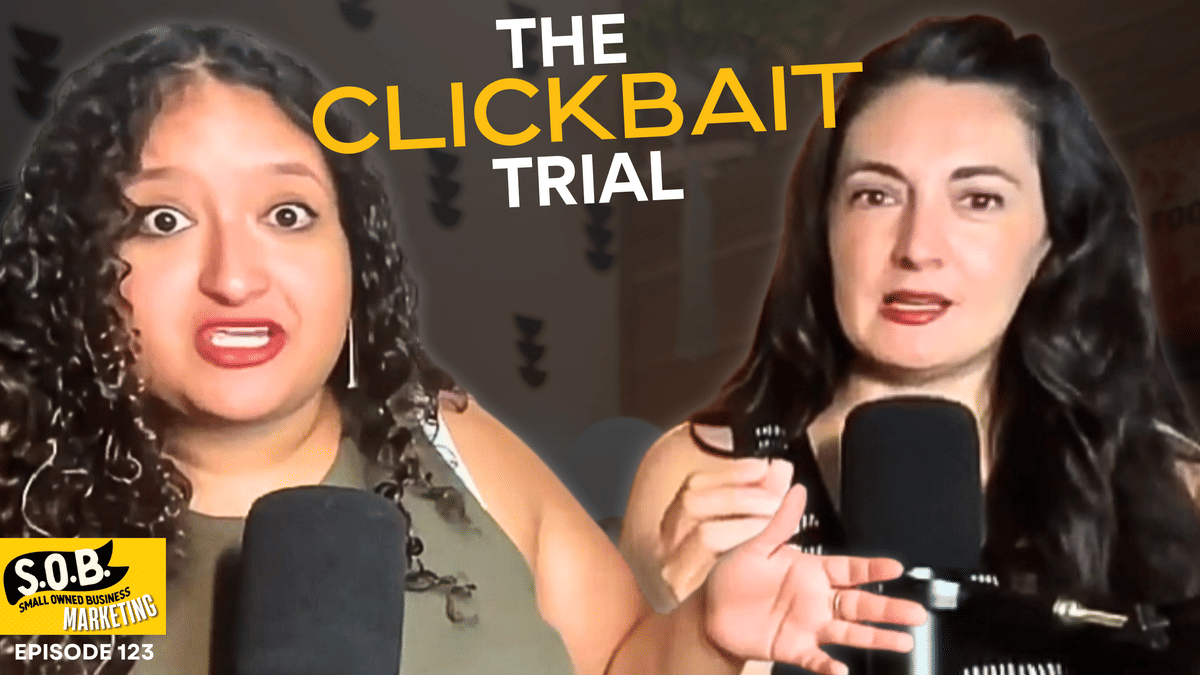
Yes. Today we are having a court case. You guys are going to be the jury. So you're going to tell us in the comment section if you agree with Chelsea, who is going to be the, I guess I would be the defendant and you are going to be the prosecutor. All right. So today's case that we are trying is to see if clickbait is a good marketing strategy.
Chelsea:
Before we moved on, we do have a TLDL chapter. Too long, didn't listen. If you're in a hurry and you don't want to hear this court case, that's fine. You can go to the TLDL chapter.
Vivian:
I object!
Chelsea:
Well, no. We understand you're busy. So you can go and skip ahead to that chapter and Vivian is going to give you a little synopsis as to what happened in the case. Kind of like reading the case notes. But when you get the chance, go back and listen to the entire thing.
Vivian:
The case that I will be presenting is that yes, clickbait strategy can be an effective marketing strategy.
Chelsea:
I am going to, I want to say I'm going to solarplex clickbait. No, I am taking the cons and I'm going to explain why a clickbait is not an effective marketing strategy and should be left behind.
Vivian:
What I love about this in particular is we tell you guys so many times that sometimes marketing is not black and white. All right. Marketing, there's lots of nuance to it. I do think that's important to understand that sometimes when we're poo pooing on stuff, there is actually a reason it's effective, right? Even if it's for negative reasons or reasons that we don't agree with all the time.
We think this is going to be the best way for us to kind of show you that. That clickbait, we all know what clickbait is. Chelsea, can you think off the top of your head of any particular example that you've had pop up over the last couple of weeks?
Chelsea:
Over the last couple of weeks? I can't give you a specific example, but I can think of how many...
Y'all, do people open Facebook anymore? I don't know.
Vivian:
Woah, I live on Facebook.
Chelsea:
Okay, my bad. Well, I was about to say I did open Facebook. OK, so I'll open Facebook, and it's always these articles of like everything's bad. Everything's bad. Read this article as to why this thing is bad. It's just, the negativity upon negativity, and they come up with the craziest headlines to get a reaction out of you.
Vivian:
There was a video that I saw on the Tiki Toki (TikTok) this week and it was interesting because it was a content creator who was actually talking about not click bait, she was talking about comment bait. Have you heard of this?
Chelsea:
Girl, this is called rage bait.
Vivian:
Yeah. Similar. That makes sense because of what she was saying. She was saying that people, and she makes money on TikTok doing this. She sells products on TikTok shop. She was saying how effective her videos are because she utilizes this comment bait/rage bait technique. Basically what she does is, she was using the example that the last video she was talking about an experience she had, but she was using chopsticks. These chopsticks were wooden and they had kind of broken. In her mind, she was like, let me replace the chopsticks. I can't get on camera using these chopsticks to eat this stuff. She's like, wait a second, let me just use it because then everyone's going to comment on the broken chopsticks. Sure enough, they were all commenting not on the topic she was discussing, but on the broken chopsticks. I guess that's the thing that people struggle with clickbait, is there's almost this sense of you're luring somebody in under false pretense.
Chelsea:
Yeah. So the actual definition of clickbait is content whose main purpose is to attract attention and encourage visitors to click on a link to a particular web page. Okay. So that's clickbait. Rage bait is the new clickbait. Because clickbait is very specifically about going to a link and clicking on a link. Rage bait. You're not going on a link, but you're getting, you are specifically doing something to make people not necessarily angry in your example, but it's usually angry. You're specifically getting a reaction out of people so that they'll interact with your content. A lot of content creators do this by mispronouncing words.
Vivian:
Well, how come I'm not making money on TikTok by mispronouncing words? I do it all day long.
Chelsea:
Because they're taking a word that everyone knows how to say and they're it very obviously wrong. So then everyone in the comments is like, that's not how you say it. It's rage bait.
Vivian:
I just need to get on there and say, I need to go get my oil changed. I'm sure.
Chelsea:
Yeah, that could maybe do it.
Vivian:
The interesting part here, and I guess what we want to spotlight today is, there's a different currency in the world now and whether you're a content creator, which if you're listening to the podcast, you are a small business owner. That's what we want to focus the conversation on is, what are the pros and cons if you've ever thought about using a click bait strategy, a strategy where I'll give you a recent example. This whole affair that was caught at a Coldplay concert via the kiss cam. Lots of people on TikTok were using it to try to tie in their particular industry or whatever their discussion point but the clickbait on those were more so they were piggybacking and using something that was popular in the geist of like, know what everyone is looking at, and the videos they're watching and then trying to lead in to their topic.
So Chelsea, I guess as a defendant or as a prosecutor, who goes first?
Chelsea:
I think the prosecutor goes first.
Vivian:
So you are basically accusing clickbait of being not...
Chelsea:
I'm accusing clickbait of being trash. Now I'm accusing clickbait of being outdated.
I want to start Vivian with one of the main reasons why you shouldn't be using clickbait specifically on your website, high bounce rates. So we talked about this in a recent episode, but a bounce rate is how quickly someone bounces off or leaves your website.
Yes, you want people to land on your website. But you want people to actually interact with your website. You want people to actually learn about your business. When you have a high bounce rate. Sure, you're getting those page views, you're getting those clicks, but no one's actually interacting with the content you're creating.
Vivian:
I object. I say clickbait is really effective when it comes to increasing your click through rate. So exactly what you're talking about. It does increase the amount of people that it is driving to your website, to your landing page. It has the opportunity, I would say you increase those numbers, you increase your odds, right? So a percentage of those people are going to be converted over to staying and viewing, reading what you have on those pages.
Chelsea:
Okay, Vivian defend this: you could get penalized by Google for using clickbait. Search engines don't want clickbait. Search engines are trying to provide their users with the information that they're looking for as simply as possible. So when you create clickbait, which let's be honest, sometimes the headline's misleading or you're not actually going to give them the information you say you're going to, Google's going to rep... One, Google's not going to show that page to anyone anymore. It's not going to get any more viewers.
And two, Google's probably not going to push out your content anymore because you've done this in the past.
Vivian:
My counter to that is, there may be a way to not get penalized because you are using click bait strategically. So could you actually use a click bait strategy, a hook, curiosity, something that is going to get somebody to click on your video, watch the first couple of seconds, go to your website, that does integrate and is in fact somehow related to the topic at hand. What I mean by this is for us, small business marketing, I always challenge myself to think if I'm being creative enough, I could find a link here. It could be a loosey goosey link, but I can maybe over time with a little more thought and effort really drive home a point and link these two topics that are seemingly unrelated, but somehow I can make them related.
It's almost like, can you be a good enough writer to get someone from point A to point B, take them through a little journey and then link the two opposing topics?
Chelsea:
I see what you mean. Okay. Well, here's the thing. Clickbait is super not cool.
Vivian:
Those are legit marketing terms you guys. We went to marketing school to learn "super not cool". Super not cool. How to do stuff super not cool or super cool.
Chelsea:
Absolutely. When you are using clickbait and you're using those headlines that are not necessarily trustworthy, you may be lying or changing the truth a little bit in a way, that's an erosion of trust with your consumers. So when you are being deceiving, your customers are going to notice that. Why would they want to purchase anything from someone who's not being trustworthy?
Vivian:
Trustworthiness is in the eye of the beholder or in this case of the viewer. What I think, maybe is you are correct. We want small business owners to utilize all marketing strategies ethically. Could there be a way to ethically engage clickbait at the beginning of a video? What I mean by that is, could you make it funny? Could you make it cheeky? Could you make it your own brand style? Would your audience actually find it hilarious and not offensive, right? Would they be like, my gosh, that was pretty witty of her to like utilize that as clickbait to get me to click on this video and not take offense to it and feel like they were just lured into watching something that they didn't want. The other part of it too is I wonder if...
My stance would be if your video is good enough in making a point, drawing a conclusion, teaching somebody something, if the video is something worth watching, that doesn't leave someone being like, that was a waste of my 60 seconds. But instead they're like, wow, that was pretty funny or I'm glad I watched that or I learned something from it. Then that erosion of trust doesn't happen because they have a different reaction to it.
Chelsea:
Now Vivian, I'd like to put a witness on the stand. I want to talk about-
Vivian:
Objection! I didn't have them on the witness list. I didn't get a chance.
Chelsea:
Mom overruled it. She told me that she was going to overrule it for me so I could bring them. TMZ.
Vivian:
Okay. Such a credible witness. Hello.
Chelsea:
Well, that's the point. Let's think about, they 100% use clickbait.
Vivian:
Oh for sure.
Chelsea:
Absolutely, and how do we feel about TMZ? It's not a trustworthy source. We're not listening to them. It damages your brand credibility when you use clickbait.
Vivian:
Then why is TMZ still in business?
Chelsea:
You know, good question.
Vivian:
It's weird because I feel like TMZ is just giving the people what they want. Okay. We are so obsessed as a society about, like you said, this is the reason that rage baiting works. This is the reason that clickbait even works is because we are intrigued to watch other people's train wrecks. We are lured in when someone promises us that they're going to be complaining. Okay. We want to hear the story about why something happened, something disastrous happened. So it's this weird juxtaposition of we don't like it, we don't respect it. I should say we don't respect it, but we like it, right?
So I think as a small business owner, if going back to what I was saying earlier, if you do use it ethically, strategically, in a certain type of way, maybe it can provide value without giving off that TMZ feel.
Chelsea:
Okay. I guess, I guess we can remove the witness. They weren't helpful. Go away.
I think this is a good one. Okay. I think this is a really great con. I think we're going to get clickbait.
Vivian:
This is going to seal the case.
Chelsea:
This is going to seal the case. A hundred percent. You're likely not attracting the right people or you're attracting the wrong target audience because here's the thing.
We've talked about this before, not all eyeballs are good eyeballs.
Vivian:
I mean, if they're functioning, we're glad your eyeballs are functioning.
Chelsea:
You know what I mean. Not all views are, what's the word, not seasoned, but not all views are good views. You want good leads, right? You want to attract people who are interested in what you have to offer as a small business. With clickbait, you're getting everybody, which isn't necessarily bad. It just might not be the best use of your time. The amount of time that you spent creating the clickbait, you could have maybe worked on something that's more hyper fixated on your target audience. It's the same thing we say with going viral.
Yes, you want your social media content to get as many views as possible. Really, what you should focus on is getting as many views as possible from your target audience, because those are the people who are going to make a purchase with you.
Vivian:
Could it possibly be a numbers game? So could you still do that simultaneously while increasing the net of fish that you are catching and bringing in?
Okay, so let's say, stupid analogy y'all. I know I'm so dumb with my analogies. Let's say today I want my target audience to be red snappers. I'm just giving them a title, like the fish, red snapper. So as a fisherman, as a small business owner, I take this net and through clickbait my net grows substantially. It becomes seven times the size that it would be if I had not used a clickbait strategy in a title, in an introduction. So I've now grown, my net has increased seven times the size. I toss it out there. And yes, I still get a mix of red snappers and not red snappers, I guess, halibut, minnows, whatever else is out there, catfish.
Which by the way, sidetrack, but I had a friend that gave me catfish not too long ago and I love me any type of fish, okay? I don't discriminate. But I had asked on my Facebook page. I was like, how do you cook catfish? Y'all have never received so much hate over catfish. People were like, don't. Catfish is nasty.
Chelsea:
Really? I didn't expect that.
Vivian:
Yeah, I got a bunch of comments about people like teasing me saying, don't eat catfish. Okay, which I still did. I loved every bit of it.
Chelsea:
Okay, let us know in the comments how you feel about catfish apparently because I've only heard amazing things about catfish.
Vivian:
Yeah. People that like catfish like catfish. I guess some people are just so anti catfish. But so my point in saying that though is really, you know, we're here to defend catfish. I'm joking.
So could it be a numbers game that by utilizing clay-click bait strategy in the title, in the introduction. I've increased my net and therefore I'm increasing the amount of red snapper I'm getting.
Chelsea:
Okay. I have two things. First thing, do you guys notice how Vivian will mess up her words and I don't say anything? Because I'm nice.
Vivian:
What word did I mess up?
Chelsea:
You said click weird.
Vivian:
I said it strangely. I didn't say "click weird".
Chelsea:
No, you said like clique or something, but I wasn't going to say anything because I'm a nice person. But do you remember how we had this entire conversation about me saying, "slimply"? Okay, just wanted to put that out there. So, I didn't mention it until now, but just to prove a point.
My second thing is Vivian, keeping with your analogy. Now you have to go through all of that fish and sort them.
Vivian:
Oh.
Chelsea:
Is it worth your time? So now you have all of these potential leads. You don't know which ones are good leads and which ones are just people who were attracted to the tit. The click bait. Darn it.
Vivian:
Did you say the tit bait? We're going to titty bait you.
Chelsea:
That was instant karma.
Vivian:
Which by the way, y'all there was a video one time that we posted on our Instagram and Facebook and it was just a, I think it was a 90 second video of Chelsea just giving some opinions about marketing topics or something. She happened to be wearing a really pretty, I think it was like a blue dress, but the collar on it was a little deep. It was a V cut.
We got a very inappropriate comment on Facebook and it was this guy who was outraged. That she was showing her boobs. I wrote back to him and I was just like, I'm sorry, what would you like her to do about it? She walks around with those things all day long.
Chelsea:
He had said, you can give marketing advice without showing your breasts. I was like, well, I'm not showing them.
Vivian:
And actually I will defend your choice.
Who would want to give marketing advice without showing breast?
Chelsea:
Absolutely.
Vivian:
Hello, y'all. Breast or no breast, I'm always choosing breast. I want breasty marketing advice, please. That's the only marketing advice in my life.
Chelsea:
I love that for you. All right. So my point, you have to sort through now all of those leads.
Vivian:
True. But because all of our SOBs, small owned businesses, that are listening to this podcast are smart and they work smarter and not harder, they have lead generations, automations set up that will sort through this stuff for them. So they're not having to hands on do it. So my pushback to that is if you have a system or a process in place, Chelsea in the past has talked through the marketing quote unquote funnel. What we tell you to envision is an upside down pyramid, a funnel, where at the top it's wider. That's casting the net. You want more people in there because then ultimately as that funnel tapers down towards the bottom and gets very small, you're sorting out and kicking out all the people that your product and service is not for. Ultimately, by the time they get to the bottom of that funnel, it's like ding ding, lucky winner. You are our target audience and you are the person that our product or service will solve a problem for.
Hopefully as a small business owner, that compels you enough that it allows you to open up your marketing to all kinds of strategies, including click bait strategy, because you have an automation that's going to do that stuff for you.
Chelsea:
Y'all, feel like this prosecutor is cooked, but let's keep going.
Vivian:
First of all, who's used the word cooked in the last like two decades? Do you use that word often? I'm cooked.
Chelsea:
No. See, now you sound like the opposite of Tim. Tim has been on me the past couple of months because I now use the phrase crash out. I'm going to crash out. He's like, you are too old to be using that phrase. He's like, you're almost 30. I told him you're also almost 30. We're the same age.
Vivian:
I'm saying basically you're too young to be using the word cooked. That sounds like a Bugs Bunny term. Like if I was Bugs Bunny, I'd be like "you're cooked".
Chelsea:
This prosecutor is back on track. You'll probably ruin your analytics if you use clickbait. Remember, marketing, we're little scientists, our analytics, our data is very important to us. So let me explain. Views are helpful. They're important. But retention matters more than you think it does. This comes back to the bounce rate. You don't want people clicking on something, skimming it real quick, going I'm not interested in this and then immediately leaving. Is someone staying and watching your video or reading your blog all the way through. The person who is consuming your content all the way through is way more likely to make a purchase with you than someone who has clicked on your clickbait, looked at it real quick and said, I'm not interested.
Vivian:
Yes. So hold on, let me think through this. You're saying it's going to ruin your analytics because you're not going to have the retention that you want. So it's just going to skew your whole analytics. You're going to get a bunch of, a boost in views.
Chelsea:
Yeah, you're getting a bunch of views, but you're not finding out what your target audience is actually interested in.
Vivian:
Okay, so what I will say, we've talked about using clickbait strategically. What if you could use it to focus on curiosity, you lead or you focus on your target audience. What is my target audience curious about? How can I use-
Chelsea:
Red snapper.
Vivian:
Red snapper. How can I use clickbait to get them to, utilize, to watch my video completely.
Chelsea:
Catfish is better than red snapper.
Vivian:
Versus misleading someone. So you don't have to utilize click bait to mislead someone. Let's use, for example.
Chelsea:
So let's not use the example I just gave.
Vivian:
Well, let's use the example of Red Snapper. You said Red Snapper.
Chelsea:
So I said a bad example of what we don't want to do, is saying catfish tastes better than Red Snapper.
Vivian:
Or saying catfish is superior to Red Snapper. Let's say I was a bait company and I did want to do some type of clickbait title, or intro to get someone to watch my full video, right? To get them intrigued enough. Using that strategically, maybe I could say something like, "this bait doubled our red snapper catch in two weeks" or something like that. Okay. I'm not a fisherman, so I don't know what the lingo is, but, saying basically we tested this bait and this is the bait that doubled our catch. You're using your personal experience. Could you take, strategically, a personal experience you have had in your business or the problem that you solve and then share that with the people you're looking to bring into your business. Right. So another way for this would be, let's say you are somebody who writes emails for small business owners. I could say something like this. This email got us double the subscribers or this thing doubled our email list in two weeks, right? So using terms that gives it a timeframe, but then also giving or sharing the desired outcome. I want my email list to double. What did they do? Right? So that's quote unquote click bait.
Chelsea:
Yes. I just want to say if you're going to do something like that, you better be telling the truth.
Vivian:
Yes. Okay, so I think we can agree both on the prosecution and the defendant's side. We can agree. Let's not be crappy and let's not mislead people or lure them in under false pretense. What I'm saying is, I'm okay with click bait if it's used in the right way. To be honest, I think all of us now as small business owners are using clickbait. How many of you, raise your hand in the comment section right now. Do it. Raise your hand if you have thought to yourself at least once or twice in the last two months, I need to figure out my intro. I need to make the intro of my videos a little better. I need to make them more engaging. If you've had that conversation with yourself or that thought, then I think to some extent you're asking yourself how can I make this video clickbait.
Chelsea:
So if you're clickbait, and this comes down to the prosecutor yielding and saying, fine, clickbait can be okay.
Vivian:
I feel like hell just froze over. I never thought you would say that.
Chelsea:
Hell would freeze over if I walked into a church. This is not that.
Clickbait is okay to use if you're using it one strategically. If you're not being, I personally feel like if you're not being aggressive and very negative. I think we're at a point with the content that we see that negativity obviously still works. We've talked about it multiple times during this episode, but I feel like it's not, it's not going to be as productive as it once was. People don't want to be angry.
Vivian:
I feel like this would be a great opportunity for me to ask the stenographer to stop and read back the definition. So use a different voice.
Chelsea:
Okay.
in different voice
"Content whose main purpose is to attract attention and encourage visitors to click on a link to a particular web page."
Vivian:
None of that says anything about negativity. We get to decide if clickbait can be used for good or for evil. And I would just say, I think the clickbait strategy actually does work. By definition, there is nothing that says that it has to be focused on negativity. That is what we have done as humans. We have this visceral reaction to the word clickbait because we have made it crappy. We have made it about bad things. But what if, what if you could use clickbait for the greater good of humans?
Actually use it to spread good stories and to spread positivity about stuff. I would think that we would then be countering this whole culture of like you're saying, there's all kinds of bad stuff going on in this world. Yes, and I'm going to choose to use a good clickbait strategy to draw my target audience in to buy my product or service in my small business.
Chelsea:
Fine. Fine. The prosecution yields.
Vivian:
Like we said, you guys are ultimately our jury. So you tell us who won this discussion or what your thoughts are. Is clickbait a good effective marketing strategy or are you just hashtag over it and clickbait should never be used? D you wish people did not take that approach to their marketing?
Chelsea, you think we're ready for a TLDL? Too long, didn't listen.
Chelsea:
I absolutely do.
Vivian:
Synopsis. If you are listening to this, we always encourage you to go back and listen to the full episode so that you could get context because that is where you're going to really learn all the things. We wanted to do this style of an episode just to prove to you that there could be positives and negatives to every single marketing strategy out there. While I did take the approach of being pro clickbait, and I convinced myself by the end of this podcast episode. Yes, clickbait can absolutely be something useful. There are a few things, bumpers, rails, to just remind you. These are designed by intention to provoke curiosity or interest in people. Just be sure you're not misleading them, and that you're not doing what Chelsea was accusing clickbait of doing. Which is actually cutting down your trust factor. The only way to do that is to proactively deliver on the promise.
If you start a video by saying a solid statement about something you're going to do, do it by the end of the video. That why that builds that trust, and instead of diminishing that, you're going to be adding to it. People are going to be like, "Oh, okay. I clicked on this video expecting x, y, and z, and that's exactly what I got".
The other thing is, clickbait is something that we've been doing since the beginning of time. More specifically, we saw it in newspapers back in the day, with headlines. That's how people got you to read their printed article or paper. It was through clickbait-y type of headlines. So nothing new, I think it just changes and keeps with the time as technology advances. At the end of the day, even with all of this AI, we are still the same humans we have always been. We love a good clickbait-y title that's going to peak interest and have me read it.
Chelsea:
So a friendly reminder everyone, if you are not following, make sure you go ahead and do that. If you haven't left us a review, which I know you haven't...
Vivian:
We read them.
Chelsea:
Yeah, we do read them. So please, pretty please go leave us a review. It helps us get in front of other small business owners. Also heads up, we want to do a podcast episode where we answer all of your questions. So send in a question. You can leave it as a comment. You can DM us on social media platforms, we're at The Seasoned Marketer. You can also email us at Help@TheSeasonedMarketer.com. Whatever works best for you guys.
Vivian:
Skirt. trying to make a screeching tire sound Before...that's brakes. I don't know if I did the sound well.
Chelsea:
No that was great. Yeah go ahead.
Vivian:
I need to work on my sound effects.
Chelsea:
You really just said skirt. skirt
It sounds like you're just saying It sounds like you're just saying skirt.
Vivian:
Okay, sorry. I'll work on that. Before we leave you guys today, we were looking at analytics a little earlier and 50% of you are not subscribed. If you are listening to this and you are not subscribed.
Do it guys, help us out. That helps to get this podcast episode in front of other small business owners. And we're here to build community. We want to make sure that you guys are well equipped to be able to do your marketing in-house without having to outsource to any fancy agency. The only way we're going to do that is by reaching all of the small business owners in this world. All of you.
Chelsea:
Y'all, go be the best SOBs you can be.
Social Media Is Changing FAST - 4 Updates You Can't Afford to Ignore in 2026
Keeping up with social media updates and changes can feel like a full-time job, which is why we do the research for our S.O.B. Community members every week! In this episode, we're sharing four important social media updates from the past few months that we've already discussed with our community mem...
7 Marketing Things Small Business Owners Waste Money On
Are you spending money on marketing that isn't actually helping your small business grow? Just because something is popular, expensive, or easy to do doesn't mean it's the right investment for YOUR business. In this episode of the S.O.B. Marketing Podcast, we're sharing 7 marketing things small busi...
Do You REALLY Have to Do Video Marketing in 2026?
Small business owners are always being told they NEED to be showing up on video but is it true? In this episode of the S.O.B. Marketing Podcast, we have a candid discussion about how your smalll business can benefit from video marketing, as video is becoming increasingly important across social medi...
Do You Really Want to Be the Face of Your Business?
If you’ve ever felt the pressure to be the face of your business, constantly creating content, sharing your life, and putting yourself out there, this episode is for you. We dig into the personal brand vs. logo-led brand debate and the bigger question behind it: What kind of business do you actually...
Is Your Business Showing Up on ChatGPT or other AI Chatbots? Here's How to Find Out
Even if you personally aren't a fan of AI Chatbots like ChatGPT, Claude, or Grok - you WANT your small business to get recommended in their search results because that can lead to more sales. But how do you even start to measure your AI "visibility"? In this episode, we share a four-lens framework f...
Google Search Console Is Changing: What Small Business Owners Need to Know in 2026
Google Search Console just got a lot more interesting for small business owners. Google is giving businesses new insight into how their content shows up across search and that includes the growing connection between your website, social media content, and the way people discover you in search. In th...
Why Should Anyone Shop with You on Small Business Saturday?
Small Business Saturday is a fabulous opportunity to increase your sales, but it's not enough to ask people to shop with you just because you're a small business! In this episode, we share questions you can ask to help you identify what makes your product, service, or experience different and how yo...
Small Business Saturday is Coming - Are You Ready?
There is MONEY to be made on Small Business Saturday! Estimates are that around 62.7 million people shop in-store and about 63 million people shop online. While this episode was originally shared in 2023, the strategies we share to increase sales during this small business specific holiday are more ...
What To Do When People Ask Your Business for Free Stuff
Small business owners get asked for free donations all the time from non-profits, event-organizers, influencers, and even family and friends - but when (if ever) does it make sense to actually say YES? In this episode, we discuss how to approach requests for free stuff from a marketing perspective a...