
Chelsea:
We are here to give you guys the marketing news, so that you guys don't have to. And in marketing news right now, I'm sure it'll still be relevant. Vivian, I don't know if you've heard about this, but Google is retracting their plan to get rid of cookies on Google Chrome.
Vivian:
Yeah, I was not aware of that until you just shared that with me because it was such a big news that they were getting rid of it. So I'm kind of intrigued by what made them change their mind. And so when Chelsea says cookies, y 'all, she's not talking about baking. Okay. She ain't talking about no frosted cookies or oatmeal cookies, which are my favorite, but what she is talking about.
Chelsea:
Oatmeal cookies? I'm sorry. No, just keep going. But oatmeal? Okay, sure. I mean, there's nothing wrong with them, but they're not my favorite.
Vivian:
What's wrong with oatmeal?
I like the raisins. I've always liked raisins. used to put raisins in my cornflakes.
Chelsea:
Jail. Straight to jail. I used to sugar in my cornflakes.
Vivian:
I think this explains a lot. I also like black licorice and Werther's
Chelsea:
Well, Werther's slap, but black licorice is gross.
Vivian:
Okay, so back on track. Cookies, besides the fact that Vivian's an old lady and has old lady taste and likes tapioca and Chelsea over there says jail to all that. The purpose of cookies on the internet are to track a person's movement online.
Google, YouTube, and Facebook, those are the top three websites you can use. They are not just like social media, are data collectors. That is the power. It's the reason that Facebook ads are so popular, because they collect all of that data and then target very specifically a group of people with their ads.
Well, Google does the same thing. If you've ever taken a Google ad out for your small business, it's all of the data that they're collecting that they're able to retarget and to put that ad in front of the most relevant people that are going to get you those clicks that they can then charge for. Okay, so that's their true power. The cookie thing was such a big debate.
or discussion point because if essentially they got rid of cookies, it meant they can no longer trail you or see where you were moving online and that would cut into the amount of data they would have available. And so I'm going to look further into this, Chelsea. I'm glad you brought this up because I'm genuinely curious to see what is the reason.
Chelsea:
Well, I can give you a little more about it. So, Google in 2020 announced that they were getting rid of cookies because remember this was the time where everyone was like privacy is very important. I don't feel comfortable with everyone tracking my information, which I will say as a marketer and then as a human being.
Vivian:
What? We're human beings?
Chelsea:
I know right?... This is such a chaotic episode already. My point is...
Vivian:
I thought we were robots.
Word to the wise, we're not letting Chelsea drink any more coffee ever again.
Chelsea:
That's facts, that's very fair. So as a marketer, like cookies are great. I get to really niche down on my target and really use my money the smartest way, right? Like it's very efficient, it's very effective. But tracking people is a little uncomfy, right? So Google had announced in 2020 that they're going to slowly phase out their third party cookies
And now recently, I want to say this week, they announced, hey, we're no longer doing that. Instead of getting rid of third party cookies, what they're going to do is they're going to allow people on Chrome, we're specifically talking about Chrome.
They're going to allow people to make an informed choice that applies across their web browsing so that they can choose at any time whether these cookies are tracking them. It's kind of like what Apple did, right? Like Apple now, when you download an app or when you're on a website, it says, hey, they use cookies. Do you want to opt in or opt out?
Vivian:
I think you brought it up from the perspective as personal for us because we're marketers and we're also apparently humans and not robots, which is a shame.
Chelsea:
Yeah. I know. Well, let me tell you, these advertisers that push for it, I'm pretty sure are robots. Just saying.
Vivian:
Well, no, because I was going to say as a small business owner, we'd be curious to hear from y 'all about this, okay? So leave us a comment. If you're listening to this on Spotify and you could leave us a comment or on Facebook, wherever you're listening to us, go ahead and just leave a comment and tell us your thoughts about this. If as a small business owner, you have a conflicted interest because like Chelsea said, if you're spending money on writing ads to promote your small business, you want that data. But is it conflict with your idea of it as a human or as a user online? Do you care if somebody tracks how you're moving online?
Vivian:
on running ads to promote your small business, you want that data. But does it conflict with your idea of it as a human or as a user online? you care if somebody tracks how you're moving online? I do think the consent thing is a really big part. I think a lot of websites do this on their own.
I do think the consent thing is a really big part. I think a lot of websites do this on their own. I'm also curious, I'll say I'm going to do some digging because if I remember correctly, whenever they the announcement in 2020, they were talking about this digital sandbox. So essentially what they said is no longer will they collect, they were still going to try to, they had created a digital sandbox.
So essentially what they said is no longer were they going to collect, they were still going to try to, they had created a digital sandbox and in that sandbox, they were basically going to dump the data, but it was going to be incrypted.
Chelsea:
Chelsea was on the Hot Topic website for like two hours this day. It would be some 26 year old who probably should be an adult by now was on the Hot Topic website for two hours.
Vivian:
No, it would be even more aggregate than that. It would be basically this many 26 year olds across the world on Hot Topic or this many people on Hot Topic website. So it was just a way to kind of remove the idea that they were infringing on your privacy. We're going to collect generalities now.
That's not as effective for targeting people, right? So love that you brought this up and I'm glad you heard it here first, you guys. We're gonna probably do a longer episode on this, revisit Cookies. I think that's a great topic because it can be a little hard to wrap your head around. So we'll do that in a future episode, but what is the actual topic topic that we're covering today, Chelsea?
Chelsea:
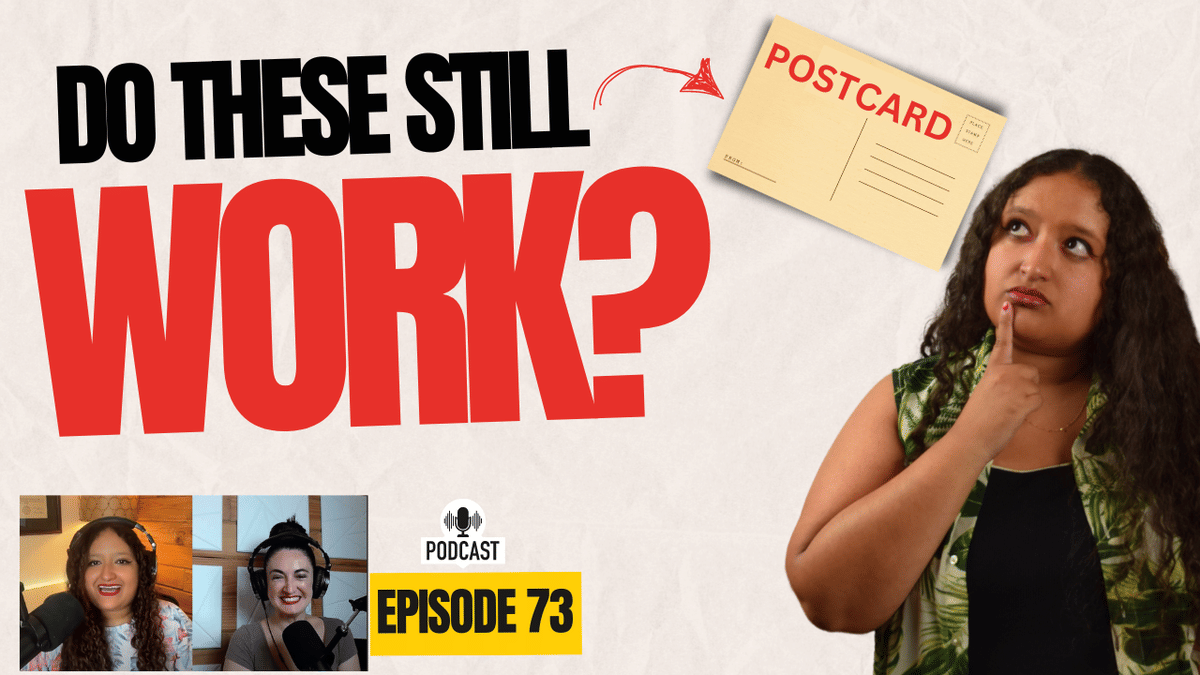
Today we are talking about direct mail marketing and direct mail marketing is still very relevant. Okay. I have some very interesting statistics to share with y 'all. You know, I love my statistics. So the USPS did a really interesting study on direct mail and different generations. for example, boomers prefer direct mail over other marketing communication methods. instead of an email, instead of social media, they'd rather get like a postcard or something. For Gen Z, this is really interesting. For Gen Z, 72 % would be disappointed if they no longer received mail. And they're actually excited to discover what they get in the mail every day.
Vivian:
I would argue that depends what we're getting in the mail.
Chelsea:
That's fair. Part of that statistic, 33%, are also more inclined to make a purchase if they see it in the mail.
Vivian:
Wow. So for you guys listening, are you surprised by any of this? Does that surprise you? Chelsea, when you read that, were your initial thoughts?
Chelsea:
I was surprised.
I do like getting mail. I like getting mail from specific, like Ulta when they send their booklets. Love that. When Carnival Cruise sends me another flyer, I don't like that. Because they send me too many. Like it's too many. Look y 'all, I don't have time right now to be going on a cruise. Please stop.
Vivian:
All right. So interesting here. I'm going to give you some real life experience that I've had with this. And then also something that I heard that I thought was pretty astonishing and it takes a whole lot to astonish this old gal. Healthcare marketing. One of the interesting things is there are different initiatives that people will do for healthcare marketing.
Obviously, Medicare, who's targeting people 65 and up who are entering into these Medicare programs, they are starting to do a little more of like the text marketing and also the email marketing. But do you know what they predominantly spend the most money on? Postcards. And if we haven't covered this, you guys, just because we failed to mention it, when we say direct mail campaigns, it equal postcards. That's what that is. It's just a fancy marketing term because y 'all know we got to give everything a new name. So direct mail. But the reason they do that is because they tap into that sentiment that you just talked about, which is they know that they still enjoy receiving mail and that they will check their mail and that that's one of the best ways that they can get new information about some of these Medicare programs.
into their hands. Now they are trying to mix in emails and they have a pretty good success rate with that, but nothing hits home and nothing gives them the effectiveness that these direct mailers do. All right. The other thing, that I heard recently that was astonishing and you jogged my memory whenever you said you enjoy getting mail from Ulta, right? Okay. There was a lady, her entire thing is direct mailers. Like that's all she loves direct mailers and she's like a specialist in it. And I watched a video of her talking about how Saks Fifth Avenue apparently they had this huge decrease in sales one year. And when they trailed it back to what actually triggered this, it was the fact that they dropped their direct mail campaign because apparently they have this thing where it's like a loyalty program.
So they have these like bucks that they call them or something like that. And people, the more you spend, the more they'll give you, it's kind of like Kohl's rewards, right? So they'll give you like $10 here and there. Well, the guy, I guess he was an incoming CEO and he was like, you know what, cut the direct mail and just send it to people via email.
And so they thought that that would be just as effective. But what they figured was that people were not coming in to make extra purchases to use those dollars because they just weren't, they didn't like opening their emails or they weren't connecting the dots, right? They were so used to getting these postcards that would tell them how much money they had in dollars. So they went back and they added the direct mail again.
Direct mailers are a little more expensive and we'll talk about that here in a second. However, what it did is if you had $20 to spend, it triggered you to go in and obviously spend way more than 20 bucks. Cause I don't think there's anything at Saks Fifth Avenue for $20. I even think you couldn't get like an eyeliner for 20 bucks there. All right, so obviously you were purchasing way more than the discount that they were giving people. And so they lost a lot of money.
Chelsea:
We had shared this on social media last year, but I want to bring it up again. In 2023, Direct Mail Marketing was the third most used marketing channel. So it's still very relevant. Like, obviously it's very relevant with that story that you just told. They lost so much money.
Vivian:
Yeah, and it's not going to be, you know, just like we tell you guys with every discussion point or every topic we bring to you on this episode is by drawing attention to this topic, we're not suggesting that this is the right fit for your small business. We think that you as a small business owner is the only person that truly knows what is a good fit for your small business. Okay?
And unless I intimately know more about your business and what you do, I cannot tell you that across the board, direct mail campaigns are good for everybody. What we can tell you and what we'll go through here in a second is it is ideal for certain initiatives or for certain businesses. There are some caveats to it. It is more expensive. There is more nuance to it.
You can't just like slap something together and throw it out there. You can't also be delivering these yourselves, y 'all. Okay. So, we'll go through all of the appropriate ways to get this done and the items that you're going to have to think about before you put a direct mail campaign together. But Chelsea, let's go ahead and start talking about when is a direct mail campaign a good idea?
Chelsea:
So I'm thinking of a specific example that you and I have. Direct mail can be great for building brand awareness and bringing in new customers. So Barrow County Farmers Market had come to us. They wanted to bring in new people, people who were new to the community and maybe didn't know about the farmers market.
So what we did is we sent out postcards specifically to a 10 mile radius around the address for where the farmer's market is held. And it was specifically for new families that had moved within the past six months. They were a specific income level. They had maybe one or two kids, they had a family. I think that's the great thing about direct mail is that you can get very specific about who you want to send postcards to.
Vivian:
That is a great example of it. If you've never done direct mail, you're just thinking - well, I just pick a certain neighborhood or I just pick a certain area and it gets blasted out. But what if those people are not really my target audience? No, you can narrow it down. And so with them, the reason that we recommended that they narrow it down to new residents is because what better way, y 'all, when somebody just moves into a community and they're new from outside the area, what do they typically look for? They'll typically look for a new dentist, a new doctor, things to do. And the reason we included families in there is because they're looking for things to do with their kids, right? So they're like, we want to get out. Okay, well, one of the nice things is if you're moving out to this county in particular, it's outside of Athens. It's not super big. It's a smaller community. And I think that's the thing that we're trying to sell them on.
Hey, you moved out here, take advantage of like having this local farmers market there that has fresh vegetables and has all this. And then I do remember Chelsea, there was something, and we didn't use direct mail campaign to it, but there was something to do with SNAP benefits too, that they had. like SNAP benefits for y 'all that don't know, that's for low income families who need a little help, right, with supplementing their grocery costs.
And so they basically give them these vouchers that they can go into grocery stores and spend X amount of money for some of the food basics, right? Fruits, vegetables, healthy stuff. They were then using them now at the farmer's market. And so if we wanted to take it one step further, they could have done a direct mail campaign to those SNAP benefit recipients promoting this and saying, Hey, by the way, did you know that now you can use your SNAP benefits at the farmer's market that's five miles up the road? So it's really great for hitting, being able to hit home that message.
Chelsea:
I think we think of digital marketing as a, we can get really specific and we can really narrow down our audience and target the people we want to target. You can do that with direct mail too. What do you think the census is? Like, I hate to tell you, but people track you, okay? They know what's going on.
Vivian:
The one thing I will say, the caveat to all this is if you guys are wondering, my gosh, well, how would I even go about researching that information?
My recommendation is there are two approaches to working direct mail campaigns The first approach is you want to decide, if you're a little on the tighter budget, you can actually just do this through the United States Postal Service And what that means is you're going to print the cards out yourself. Of course, it has to be all formatted in the way that they want. And we'll get into that later.
That takes a little longer but it is more cost efficient. The other way which I prefer because it's a little less hands -on and you're not doing the bulk of the work is you find a local printer that you can work with. You can tell them, hey, this is what I'm thinking. Are you able to pull a list for me of X, Y, and Z? This is probably the budget I'm looking to stick around. They're going to charge you for that list because that's work that they're having to manually do. And also they will charge you for like printing the postcard and then also the postage, right? But usually their postage rate is better sometimes than you could get on your own. So that might work out in your benefit. So first thing to decide is, am I gonna try to do this on my own or am I gonna find a local printer that can help
Chelsea:
Absolutely. And I'm gonna be honest, I also prefer working through printing companies. They have the experience. They're like a well oiled machine, so they can get it out pretty quickly for you. And if you pick like a local printing company, then you're helping a fellow small business out and they'll probably give you like a decent deal.
Vivian:
I've done it both ways, Chelsea. Like when I worked at one of the other companies years ago, they didn't want to spend money on working with a printer. And so I had a shoestring budget, and had to put all this together. So it's doable. We don't want, if you guys think this would be a good fit for your business, we don't want you to deter away from it because you don't have a big budget. Just kind of see how much it would cost to do it on your own.
Also, you can ask a printer for a quote. So anytime you approach a printer, you can ask them for a quote before you sign up to do any of the projects with them. So that way you know ahead of time what that's gonna look like. the thing with the, if you're going on your own with the United States Postal Service, I would just say go online. They have a wonderful resource on their website that outlines the process of this. And also go make friends with the people at your local post office.
I'm telling you right now, I have met some of the nicest people there because, they even have a different section for it. So like, for example, I remember when I was doing this in my twenties, I walked into the post office and I said, hey, I'm interested in sending out postcards. We would provide the postcards, who do I need to talk to? They sent me around to the back of the building. I had to drive my car around to the back of the building because they had a whole separate entrance for it. They had people that were dedicated to it and they even would supply me with the little mail bins to bring the mail in. So that way it was, you know, postal service certified all this. So they're very helpful. You just have to ask and, just go in there and tell them like, hey, I'm starting from scratch. I don't know much. So please just walk me through this. How would this work? And what would I need to pay for?
Chelsea:
Absolutely. Just don't be afraid to ask questions. Something we say all the time, ask questions. So. You have to know what your budget is. Okay. Don't go into this blind because that's going to make it very difficult to understand what you need to do.
Vivian:
Yeah. Let's say I would say I have $750 that I'm willing to spend on this, go do the research and then you can see how much you could get for $750 and what all you could do. It may mean you're not sending out as many postcards because you're having to pay for other stuff. You have to pay for the postage. You have to pay for the printing.
Chelsea:
Are you going to print on one side or both sides? That's going to cost more money. You're also gonna wanna know whether you're gonna print in color or black and white, because that's gonna change how much money you spend.
Vivian:
Yeah, color printing is always a little more expensive. Funny story years ago, this is true life. I was working with a physician and we did a postcard campaign. I presented him the postcards, he loved the imagery. He was like done and done. And he's like, how much is black and white. I shared with him now I always price stuff in color because y 'all when's the last time you got something black and white in the mail.
Chelsea:
If I got something black and white, my first impression would be that someone died, you know? Or like it's a crematorium or something. that's my first impression. Like if your postcard has like two people smiling on it, but it's in black and white, I'm gonna be like, okay, someone died. Why are you sending this to me?
Vivian:
Okay, so I priced it for color and I guess maybe it was a little too rich for his taste and he asked me, he's like, what's the black and white cost? I'm like, well, I really don't recommend that we do that. And he insisted he wanted it. So I gave him black and white cost and it was significantly lower because we're sending it out to quite a few people. So he asked me to do black and white and I did not feel good about that.
Now listen, very different if you're sharing something with a lot of text, maybe, right? But like Chelsea said, this kind of goes into the, you printing front and back? So maybe the front of it has an image and you could get away with doing just the front in color and then the back only has text. So then you could get away with doing just black and white on the back.
You know, these are all things that are going to affect your cost. Let's really quickly mention talking points that we talked about in regards to budget, are you doing just front? Are you doing front and back? That's going to affect your cost. The amount of postcards you're going to do is going to affect your cost because remember you're not just printing the postcards, you're also paying for the postage.
Then also, if you're targeting the mailing list, that list is going to cost you something. The black and white variation, which we hope all of you choose color. We live in a colorful world. Please choose color.
And let me go back to the mailing list thing. What could save money is if you guys are targeting and doing a campaign that's targeting people that have already purchased from you, current customers, like let's say Sephora is like, we provide the printer with the mailing list because we have the detailed information, right?
But you're not gonna be able to do that unless you guys are capturing somebody's mailing address. Okay, so if you're a spa and you are only capturing people's email addresses for whatever reason, then you wouldn't be able to take advantage of the direct mail. But that would eliminate that cost. If you provided them the list, then obviously they're not gonna be charging you for multiple and multiple lists. And then also remember, if you're using a printer, that's going to affect your cost because a lot of times they're not just going to charge you when you secure a quote from a printer for direct mail fees, you're going to see that they're going to add a line item in that quote that typically says like labor. Whoever they are utilizing on their team to take them from the printer to the post office.
Chelsea:
Yeah. Before we move on, Vivian, two things that we're forgetting for budget, the size, because postcards come in two different sizes. You can do, I want to say three and a half by five, or you can do six by nine. Okay. Yeah. Typically you'll get like a four by six postcard size. So if you go on something like vistaprint .com or canva .com, or you can easily just put in Google like standard postcard sizes, I think there are actually three different ones. There's the really small one, the medium sized one, and then the jumbo ones that I know a lot of you guys get in the mail. And those are really effective because they stick out.
When it comes to postcards and direct mailing, there are a lot of rules you need to follow because it's mail, correct? Like they need to find, they need the address and the barcode. So if you don't want to spend the extra money on help with the design, I'm going to explain to you guys the rules that you need to follow. I'm going to preface this by saying we'll link in the show description a link to the image on USPS so that you can visually see it. And I'm also going to tell you guys what I like to do is I like to take a screenshot of that image and then overlay on top of my design so that I can see how everything lines up. This probably sounds so confusing. Let me start.
So for one postcards cannot be smaller than three and half by five. OK, if you want to send out your postcards first class rates, then it has to be no larger than six by nine. If you want to do standard rates, it can be no larger than six and one eighth by 11 and a half. Okay, so that's sizing.
Any wording, any logos, any important art has to be one sixteenth from the edge. If it's closer than that, it's probably going to get trimmed during the printing process. You have to leave a one by one space in the upper right hand corner of your design for like on the front of the postcard for postage. Okay. So that's what they cut like. So basically, know, a stamp needs to fit in that area.
Okay, there should be no more than 7 % of ink coverage, so really don't put any ink there, in the barcode areas to ensure that the scanning machines and the postal workers can all read. The mail barcode, the barcode that you see on postcards is going to be about three inches by five eighth inches. It can be included in the address box if there is three and a half inches of horizontal space available in the address area. If there is no space in the address block, then it is going to be placed on the bottom of the postcards toward the right corner. So you're gonna wanna leave a three fourth inch by four and seven.
You're also gonna wanna keep important design elements outside of this space because again, it's gonna be covered by a barcode. This all sounds so confusing. That's what I'm saying. We're gonna link to a visual. It's like a template. Again, what I do is I like to like take a screenshot of it and then overlay it on my postcard design.
Vivian:
Let's say that you don't want to mess with the design, like you just want them (printing company) to put it together. They have graphic designers in these print companies that will do that for you. That's going to come out a little bit more of a, you know, added cost. So if you are going the route of doing it yourself, like Chelsea said, do what she does and take it, import it into whatever.
Once you get the hang of it though, once you've done one, you're like, it's really easy. Just make sure that my design and keep everything within this area and it should be good to go. the other thing I do want to bring up with regards to direct mail and you guys, please refer back to, the website. If you, to the usps.com website, if you have chosen the route of doing this on your own and you're going to work directly with the USPS, you know, people. There is something you could go in there and actually for your small business, you can apply to get, you know, that insignia. So what happens is your business can apply to get an account to do direct mail postcards. That account, basically you kind of feed it like it's like you'll put money in there and then that's what they use.
to pay the postage that you're paying for particular like, you know, routes that you want to send to. When you're working with a printer, you're using theirs. Okay. But what this does is it drops down the price. So you're not paying, how much are stamps these days? Chelsea, I don't even know.
Chelsea:
I was going to say you're asking the wrong person. Whenever I need stamps, I say, Hey, dad, can I have a stamp?
Vivian:
Okay. So you actually pay, it's lower than what you're paying for postage because it's a bulk rate. So you can apply to get that for your small business. So that way you're not paying this outrageous fee for every single one of the postcards that you send.
Chelsea:
I just want to stress again that all of this probably sounds kind of complicated. It's not. Vivian told you she did it when she was in her twenties. Okay. Or you can get, well, I'm just saying like you were fresh out of college and you were doing this, killing it. So you can figure it out.
Vivian:
Yeah, and I do hope that least this conversation sparked some interest. The one thing that we want you guys to just recognize is there is a lot of talk about social media marketing, but let's not forget about some of the more traditional methods that we have available to us because they are still effective. As Chelsea said at the beginning of this podcast, she gave you guys some of the data points, okay? If people are still looking at their mail and it's still effective and it makes sense for your small business, why would you want it to react to the mail? Is it a little more expensive? I that. I'm giving you an example of what I'm hoping to take that we will start to implement. It has always been my goal because we are here for small businesses.
Do You Really Want to Be the Face of Your Business?
If you’ve ever felt the pressure to be the face of your business, constantly creating content, sharing your life, and putting yourself out there, this episode is for you. We dig into the personal brand vs. logo-led brand debate and the bigger question behind it: What kind of business do you actually...
Is Your Business Showing Up on ChatGPT or other AI Chatbots? Here's How to Find Out
Even if you personally aren't a fan of AI Chatbots like ChatGPT, Claude, or Grok - you WANT your small business to get recommended in their search results because that can lead to more sales. But how do you even start to measure your AI "visibility"? In this episode, we share a four-lens framework f...
Google Search Console Is Changing: What Small Business Owners Need to Know in 2026
Google Search Console just got a lot more interesting for small business owners. Google is giving businesses new insight into how their content shows up across search and that includes the growing connection between your website, social media content, and the way people discover you in search. In th...
Why Should Anyone Shop with You on Small Business Saturday?
Small Business Saturday is a fabulous opportunity to increase your sales, but it's not enough to ask people to shop with you just because you're a small business! In this episode, we share questions you can ask to help you identify what makes your product, service, or experience different and how yo...
Small Business Saturday is Coming - Are You Ready?
There is MONEY to be made on Small Business Saturday! Estimates are that around 62.7 million people shop in-store and about 63 million people shop online. While this episode was originally shared in 2023, the strategies we share to increase sales during this small business specific holiday are more ...
What To Do When People Ask Your Business for Free Stuff
Small business owners get asked for free donations all the time from non-profits, event-organizers, influencers, and even family and friends - but when (if ever) does it make sense to actually say YES? In this episode, we discuss how to approach requests for free stuff from a marketing perspective a...
Vendor Market Red Flags: Do NOT ignore these!
Vendor markets can be a goldmine for small businesses - OR a total waste of your time, money, and inventory. Over the years, we've learned there are a few red flags you can look for to help you determine whether participating in a specific fair, pop-up, craft show, farmers market or community event ...
Should You Still Avoid Boosting Facbook or Instagram Posts?
Meta has updated their ”Boost Post” options recently, which means we need to reassess whether our ”NEVER BOOST A POST” advice still holds true in 2026. If you’ve ever wondered whether that little “Boost Post” button is worth your money, in this episode we’ll cover: - how boosting works now in 2026 a...
Mastering Google Merchant Center for Small Businesses
Looking to get your small business’s products to appear in Google’s AI overview or products page? Then this week’s episode of the S.O.B. (small owned business) Marketing podcast, is a MUST LISTEN. This week, Vivian and I are sharing everything we know about Google Merchant Center, what it is, how it...