
Intro
Chelsea:
Hey everyone and welcome to the S.O.B. Marketing podcast. Where we celebrate to S.O.B. you are, and if you haven't figured it out yet - we mean Small Owned Business, we don't mean S.O.B...
Vivian:
Listen, we know that as a small business owner you are working hard on the daily to keep your business fully operational while trying to promote it. And while some days it may feel like the business is owning you, if we're being honest with each other I bet you would admit that you wouldn't give up the insanity for anything.
Chelsea:
Our commitment here at the S.O.B. Marketing podcast is to give you the real talk, what works when it comes to advertising, marketing, and promoting your business. And then what doesn't really work.
Vivian:
And Chelsea and I promise to always keep the conversation real.
Beginning of Episode
Vivian:
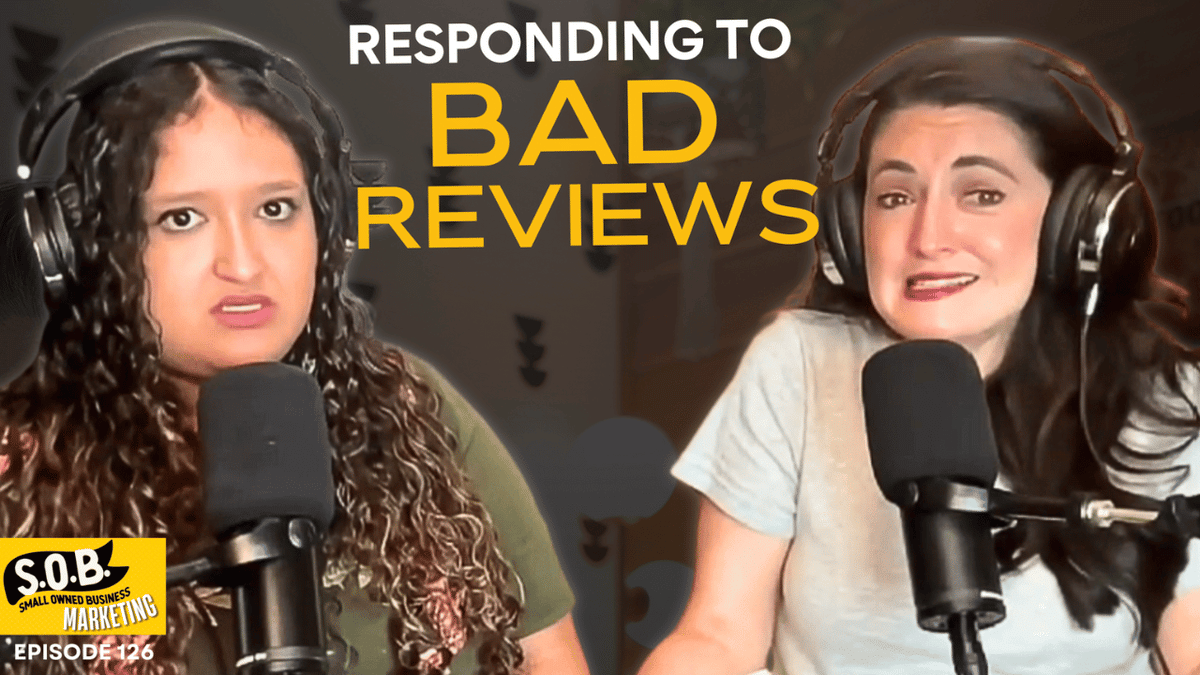
Welcome back to another episode of the S.O.B., small owned business because y'all know we never call you son of a beep. I just beeped myself out. Marketing podcast. I'm here with my beautiful sister Chelsea. If you guys are new here, just a friendly reminder, we are a marketing sister duo, 15 year age gap. Which means we kind of approach marketing and life a little differently, but that makes for interesting topic conversations. If you're listening, we want you right now to subscribe because you're going to want to listen, binge, a couple of episodes to get a good overview of the marketing tips and discussions that we have around here. As always, you guys, just remember, we have a TLDL section at the end. If you're in a hurry right now, because you know you're out there running a business, duh, you can always come back and skip to that chapter. Listen to it, get a brief run down, Chelsea walks you through it, and then earmark it, come back and listen to the full length episode. So Chelsea, my beautiful, spicy little sister, what topic are we covering today?
Chelsea:
Okay, y'all, today is going to be a great conversation. We are talking about Google reviews. I know, and how to respond to negative reviews. When do you take it by the chin and say, we're sorry that you experienced this? When do you stand up for yourself? Because as a small business, there are times where you get a review and you're like, that's not what happened. So today we're going to talk about when to stand up for yourself, how to do it, because there's definitely a wrong way to do it.
Vivian:
Chelsea and I did not want to call people out on this episode, but we're not going to name any specific names. I just want to say this topic came up, we were throwing around ideas about things that small business owners are just kind of having to deal with in 2025. I think because I am on TikTok and it is a little unhinged, man, you guys, small business owners, I see you doing some, you wilding. You're doing some wild things on there with Google reviews that are negative. I think someone just needs to have a conversation about...we get it. We understand nobody likes a negative Google review. We wish all of them. I mean, hello. We used to start our podcast by saying, Chelsea saying, leave us a five star review.
Chelsea:
We still want you to do that by the way. Still leave a five star review.
Vivian:
We don't want anything less than a five star review. But the truth is when you're running a small business, people's personalities, people's experiences, opinions, you're bound to get some negative reviews. It just comes with the territory. Today we're not just going to be focusing on the negative, but we do want to give you guys a little more guidance or just have an in-depth conversation about what should be considered before we take action and get super defensive and stuff like that. Love to have a two-way discussion about this. So if you guys have any thoughts throughout this discussion, please leave it in the comments below. We'll try to address them on Instagram stories or on a TikTok or something, but we would love to get your opinion on how you have dealt with something similar or how you would approach something.
Chelsea:
Yes. Okay, Vivian, I want to start this conversation by saying you need to ask for reviews. Reviews are a necessary, I don't want to call them evil because they're not, they're helpful. How often do you decide to make a purchase with a business or decide between two different products because of the reviews? You go through it in your daily life, people are doing the same thing for your small business. Reviews are very important.
Vivian:
They are necessary in this day and age. Let's also talk about the fact that, I think reviews are a big indicator of whether a company or a business is legitimized. Okay. So let's look at it like this. You're going to try a restaurant. You're traveling through town. You're going to try a restaurant. Are you going to select the restaurant that has one review and it's a three-star review, or are you going to go to the restaurant that has 2,000 reviews and they're 4.5 average? So I think that's the thing is you know as a customer or as a consumer, you're going to be taking a gamble if you go to the one review and it's like a three, you know? I think it's just an indicator to, a signal to potential future customers and you want to be sure that like Chelsea said, are accepting them. You are encouraging people to leave those reviews. Unfortunately, that does mean you're going to get some that are less than five stars.
Chelsea:
Vivian, let's take a step back. You mentioned restaurants. I want to ask your opinion on something. I went to a restaurant the other day. Like I told you guys, we're not going to name any names in this episode.
Vivian:
They're anonymous.
Chelsea:
Everyone's anonymous in this episode. But I went to a restaurant, they came out with the bill and well, they came out with the handheld, you know, that people have now.
Vivian:
Cause no one's receipts anymore.
Chelsea:
No one's printing receipts. They bring the handheld out. OK, so we go through the entire process. I pay. Then he slid a laminated QR code saying, please leave us a review. Is that a good way to go about it, do you think?
Vivian:
I think that's one of the many options you have. I wouldn't dog it for any reason. I think you're a small business owner, you have a couple different options. Either you're handing out, either you are printing receipts and at the bottom you're including a QR code that says leave us feedback. That's very common these days. Think about it though, if you guys have been to a coffee shop, you saw that QR code, you still crumbled up your receipt and threw it away, you didn't leave a review, right? So I don't know that those are as effective as maybe taking that extra step. I love that it's laminated, you don't have to make very many of them if the QR code changes, you didn't spend a whole lot of money on it. Literally, he prompted you, he said, please leave us a review, or he just slid it?
Chelsea:
Well, he didn't say anything, he just slid it. I think in my opinion, if he had said, could you please leave a review and then slid it over, I would have been more comfortable with it. I still left a good review because it was phenomenal. Absolutely delicious.
Vivian:
Where'd you guys go?
Chelsea:
We just said we're not naming names.
Vivian:
I'm sorry.
Chelsea:
Well, actually, this is a positive, so I could name it. Naan, the Indian place that just opened in Nexton.
Vivian:
It's on my list.
Chelsea:
Oh my God. Y'all it was phenomenal. So good. It was delicious.
Vivian:
Even more important because they are a brand new restaurant. So now is the time to try to bump up those reviews because, remember Google Maps is relying on you guys to get those reviews. It's part of the way they kind of...
Chelsea:
Decide who gets to be shown at the top.
Vivian:
Exactly.
Chelsea:
Yes. Another way that you could do it as a restaurant, you could laminate your QR code and then maybe just put it in one of those sign holders and just leave it on the table. You would have to create a little more of those but that's also an option.
Vivian:
Or you could try to automate it. Maybe if you have some type of email list or if you have them give you their cell phone number for rewards, right? So they sign up for a reward system that you have you could easily see if your POS, Point of Sale System, has a thing where it can automatically send them a text that says, hey, thanks for coming in. Do you mind leaving us a review? Literally, they just click the link, and then it takes them to the Google review box. Many different ways to approach this, to ask for reviews.
Chelsea:
Yes, absolutely. Okay, Vivian, my second point I want to say before we get into the people using reviews for evil, you need to respond to all reviews, not just bad reviews. You also need to respond to good reviews. It's good practice to respond to everybody just because it shows your consumer that you care. Because be honest, you do care.
Vivian:
If you're on the other end, sighing right now, if you're listening to this and you're like, that sounds exhausting, there's no way I'm going to do that. What I would recommend is have a Word document where you keep canned responses. You can customize them as you go, right? So hopefully you're just not going to be copying and pasting, but they're going to be used as a foundation for stuff you can tack on. What you could do there is, have a canned response for a positive review or maybe create three different versions of it. Okay, positive three stars on up, or maybe four stars on up. Here are three things that we toggle between telling people, right? It's like, thanks so much for the feedback. We're glad that you enjoyed your visit. Hope you'll come back and see us again. Something like that, three variations. Then you can have three variations to address negative ones. In there, it could be something like, we're so sorry that your experience was less than stellar. If you want to talk about your experience, email us at or something like that. Right. So you're giving them another way to connect or you could just address it right there, which is a really good option too.
Chelsea:
I'm so glad that you said having three different variations. Nothing pisses off people more than getting a canned response.
Vivian:
Right. Well, and that's why you want to, listen. If you're going to ChatGPT it, because I know some of you S.O.B.s that thought just crossed your mind. Great, I'm going to ask ChatGPT for 10 variations of this and that. Fabulous. Go ahead and do that. But what I want you to do then with those variations is to go in and make it sound like you, like your business. So make it sound conversational. That way people don't think of it as a canned response. I do think there's a way for you to keep it, if you have three different variations and even still, like I said, you're using that as a foundation. If someone leaves a really great response and it's a paragraph long, literally you copy and paste one of them. When you're pasting it in there, you go in and you add a sentence about one thing that they included in the review and that way it feels very personal. It feels like, you've read my review and you're saying something back to me that I left in the review.
Chelsea:
Yeah, that is a great tip.
Vivian:
I do this with text messages, you guys. Sometimes because in one of the roles that I have, I sometimes have to respond back to texts. If it's something that I know I'm going to be replying to a lot of people, kind of the same thing, I'll copy and paste it, but then I go back in and I'll say like the person's name or I'll add something in there to let them know, hey, I see you. I know it's coming from you.
Chelsea:
Yeah, this, it really does matter. When I worked at a place, I'm not naming any names again. We're going to go back to being anonymous. When I worked at a place, they had one singular canned response for bad reviews. So I used it because I wasn't supposed to deviate from it. You got to use this specific response, that set this person off. They were so upset because they were saying, you don't care. You didn't even read what I said. All you did was copy and paste the same thing you tell everybody else.
Vivian:
Well, this is where most of the conversation is going to lie today, but when somebody is feeling like they had a bad experience, the last thing they want to do is feel unseen.
Chelsea:
Okay, Vivian. So let's get into the conversation. When you get a bad review, what do you do? When do you stand up for yourself? When do you just admit that, hey, you know, it was our shortcomings? We kind of messed up here. How do we go about this? I think the good standard, best place to start is, is "what happened" true. I'm not saying go, "of course that didn't happen. We would never do that". I mean you guys need to investigate. You need to check your records. You need to talk with your employees, your staff. You need to investigate and see whether what they're saying happened or not.
Vivian:
Can we also talk about the fact that it's okay to not, I know it feels like when we get a bad review, it almost feels like somebody's attacking you. So you feel like you have to be on the defense really quick. You're like, if I don't answer it right now, then it's going to get out of hand and it's going to get worse. I want to give you explicit permission right now to take time to come up with a response or to approach the review. So what I would say is, it is okay to let somebody know that you have seen the negative review. So what I personally would do is say, we're so sorry that you had a bad experience. We're going to be investigating or looking into this. We'll get back to you. Whatever it is, figure out a way to tell them basically, I saw the review, we're doing something about it, or I need more time to put all the puzzle pieces together. There's nothing wrong with saying that. I think that's where maybe sometimes small business owners, the urgency trumps being a little more level headed because you do feel like, it's an attack on my business and I want to set the record straight. We want you to set the record straight, but we want you to have all the moving parts before you speak to something that may be, and not that the review may be entirely true, but there may be parts of the review that are true.
Chelsea:
I'm glad you said level-headed. You're feeling some type of way about it because your business is your baby. If you respond too quickly, you might say stuff that you shouldn't have said.
So let's say what they said is an actual issue. You do the research and you're like, oh darn, we really dropped the ball there. Make sure that you give an apologetic response with empathy. I'm so sorry that happened. Acknowledge the issue. I can't believe that Chelsea would, I don't know, I was going to say call you the B word maybe, I don't know. I wouldn't do that. But I'm using me as an example. Okay, so I'm so sorry that happened to you. We definitely do not condone Chelsea cursing at customers. We apologize for this experience and here are the steps that we're taking to address the issue. Chelsea has been let go. We weren't even going to bother to try to retrain her, but we could have retrained her. I don't know. Don't add that part, but that's an option.
Vivian:
That's TMI.
Chelsea:
Don't add that part, but you could say we're retraining our staff or you could say this person was let go. Let them know what you're doing to make amends.
Vivian:
Yeah, agree. We do have a TikTok video. If you guys want to go to our TikTok account and watch this, there was a particular business where the cursing thing actually happened.
Chelsea:
Well, that's what I thought of.
Vivian:
Unfortunately, what happened was that, well, I don't want to say unfortunately because if it happened on the property of this business, the business is responsible for it because their employee did it. A person was filming, a wait staff member came in, called the girl the B word and she caught it all on her Instagram. Of course, you don't think that's going to blow up, what was worse was not the actual thing that happened. It was the owner's response. In there, I did a video where I basically am deconstructing the apology video, because it was pretty egregious. It was pretty bad in the sense that you could tell the business owner just didn't want to even address it. So she never apologized and she never addressed the actual thing that happened. Much like a Google review, I think that's what gets people in trouble. So far you've heard Chelsea say, let's go ahead and let's stick to facts. Okay. So let's not reply with something emotional, but instead go ahead and acknowledge someone's negative review, tell them we're going to be exploring or we're going to be doing in depth investigation or whatever it is that needs to be done. Then go in, find all the puzzle pieces. When you come back to actually write your response to them, stick to just the facts. You don't need to add anything else to it besides just like offering an apology. Just saying, you know, we're truly sorry or something like that. But telling them when you walk through it earlier and you said, we don't condone using curse words. It's never appropriate to for any of our team members to ever use that kind of language to a patron or to a customer. I wouldn't, you can offer a follow-up like saying very clearly we've decided we're going to retrain our team members or, that person has been pulled off the floor or whatever it is. But I think that's where the less you say sometimes the better. Communication is a lot about what you leave out. You don't have to write a whole dissertation to them about what actually happened. Just try to sum it up pretty quickly and offer your apology and then offer them the resolution that you have.
Chelsea:
Yeah. I think that's in my opinion, the key. Informing people what the resolution is. Yes, we are working on fixing this problem. You apologizing, but not doing anything about the issue. That's not helpful.
Vivian:
Well, I guess this is...So take that example where the person happened to be called the B word, okay? As a customer, what I want to know is, I can understand from a business owner's perspective, it was an employee that did this. You as a business owner, you're not up there with these little, what do you call it? Marionette strings.
Chelsea:
You could have just said puppet.
Vivian:
Yeah, you're not a puppeteer.
Chelsea:
There you go. Yes. Master of puppets.
Vivian:
You're not mastering puppets.
Chelsea:
No, master of puppets.
Vivian:
You're not a master of puppets. Okay.
Chelsea:
It's Metallica!
Vivian:
You're not a master of puppets. So everyone's got free will. I think people understand that. If, as a business owner, you're as appalled about it as they are because you're like, hey, that's not appropriate. Just don't be saying that to a customer. Then it's like, okay, I can acknowledge that you've apologized to me. You personally didn't have a hand in it, but I also want to feel safe enough that when I go in there, if I were to give you another chance, I don't think this would happen again. That's the key point, right? This customer may not ever come back. But if with an apology or by addressing the review, you can tell them, hey, you know, give us another try and this, this isn't going to happen again. If there's some type of, I don't want to say guarantee, but you're leaning towards that and you're like, I do feel that she addressed the issue. So if I go back, I don't think anyone's going to be cursing at me.
Chelsea:
STOP wasting your time Googling, "how to market my small business".
Chelsea:
What if someone leaves you a review and it is egregious, it is a lie or maybe it's, what is it? Dramatized? That's the word I was looking for. What do we do? Okay. You need a very measured defense.
Vivian:
Can we talk about that word, measured?
Chelsea:
Sure.
Vivian:
What's a measured defense look like to you?
Chelsea:
Measured means you spent time thinking about this. You put in the effort and took the time to really decide what you want to say and what you don't want to say. Because the way that you communicate is very important as a business owner. Vivian, do you have maybe some guidelines to help people decide whether or not their defense is measured enough?
Vivian:
Yes. Here are four clues. It's like blues clues y'all. Did you have a measured defense?
Clue number one, you assess the situation first. Okay, so if you actually, like Chelsea said, took time, pause, read, understood what was being said, who said it and why they were saying it, that is clue number one that you are taking a measured defense approach.
Okay, clue number two, you choose an appropriate level of response, okay? You're not going off the...
Chelsea:
You're not then instead calling them also the B-word.
Vivian:
Exactly. You're not cursing at people in your response, all this stuff.
Chelsea:
Could you imagine, real quick, could you imagine if someone said, I was in this restaurant and someone called me the B-word. And then the business owner came on and said, no one called you the B word, B word. Like, can you imagine? Please don't do that.
Vivian:
I mean, it would kind of be interesting to be like, I see where they get it from. Right.
All right. Clue number three that you're taking a measured defense approach is going to be that you stay professional and focused. All right. Like we said, stick to the facts. Avoid personal attacks. Do y'all ever see and notice that when someone gets really mad they start attacking the most random stuff. Well, your hair is blah blah blah, it's like bro that's not even a part of anything that was discussed. This review had nothing to do with that. Can we stick to the facts please and avoid the personal attacks?
The last clue is you aim to resolve. We talked about it a little earlier in some of the discussion, but that is your key indicator that it's a more measured approach is that you are actually wanting to give a solution. That you're not just responding because you feel like you have to, but that you genuinely want the person to have a better experience the next go round and so therefore you are doing something to help that.
Chelsea:
Other things to note. One: report the review on whatever platform it's on.
Vivian:
If it's a lie.
Chelsea:
If it's a lie. Yes. Right now we're talking about if your reviews, if the review is a lie. Okay, go ahead and report the review. Will it get taken down? Maybe yes, maybe no.
Vivian:
Guys in our experience, that's the one thing. Can I tell you, I get so many people all the time. They're like, can we can we just take a Google review down? No, that's not exactly how it works. Google has very strict rules and if you haven't polished up on it. I highly recommend that all small business owners do because like we said, Google reviews are such an important part of growing your small business. So go in there and just reread what Google says about getting a review taken down. You can flag it as inappropriate, but it's got to be something that is either racist or it has profanity in it or it's an outright lie and you can prove it. So there are things that it wants to see.
Chelsea:
Yes. I'm glad that you said prove it. Y'all, if Google is going to look into taking down a review, you're going to have to show some proof.
Vivian:
Or it's something like, I saw recently on another account that... it was a coffee shop. They had gotten a Yelp review and the Yelp review was actually four stars. So it wasn't bad. It was a okay review and the business owner came back and basically made a TikTok video about the review and then laid into the person in the review, got it taken down, all this crazy stuff. The customer was like, hey, I didn't even leave you a bad review. I just said X, Y, and Z, there were things that you could have done better. So it spawned this whole thing on TikTok. I thought, wow, all of this could have been avoided had you just responded to the review and said, hey, we're sorry, we'll try to do X, Y, and Z next time. Besides the point, my thing is then this person, when I noticed that it had gone viral on TikTok, a lot of people started going on there and leaving one star reviews of this business. Okay. Well, the business, the one thing they can do to protect themselves is literally say, we don't have any record of you patronizing our store at all, or basically saying you've never come into the business. How are you leaving a one star review? You're just doing this off a TikTok. It's not that you actually experienced my coffee, my business, any of that. So I do think that that's where you can flag those for Google. This played out on Yelp, but Yelp has their own things that you guys can do. Just read up on those as well. But for Google, you could easily flag those and what you could put in the message is basically, this person has never come into my establishment.
Chelsea:
Another great idea for or to add in your measured defense, ask to take it offline. Y'all, this does not all have to be public. You can have the conversation with the disgruntled customer, not in public, like offline. Say, hey, email us here, or you can call this number.
Vivian:
Let's talk about, okay, if ideally, look at it this way, you guys. There's a little pipeline. Using the example of the restaurant you went to. Chelsea goes into the restaurant, has an experience, pays, somebody leaves that scanned QR code thing, she scans it and she's able to leave a review. What would be even better is if this business somehow has either through implementing some type of platform, because there are people that do this. The one I'm thinking of right now is BirdEye. They do this. There are cheaper options, you guys. I know BirdEye is expensive because I've looked at it myself, but there are cheaper options out there. Basically what you can set up is the reviews will go to a system like BirdEye. It collects the data. If the data is all positive and they're giving you above four stars, then it actually will send it to Google or it opens up the Google review box. What that does is it filters out and it allows you as a small business owner to address the negative ones before they even end up on Google review. Now, yes, Chelsea can always go ham, go rogue and literally just say, I'm not scanning anything and I'm just going to go straight to Google and leave the review. But the majority of your people are going to leave you review after you prompt them. Okay, so scanning that QR code like you said. What you do is for all of the reviews that you get one star, two stars, the system catches it and then you address it. Right? It gives you an opportunity to go back in, fix something, make that customer feel better. After you've resolved their issue, they may go back and leave you a good review. It keeps that one to two star reviews off of Google. So there are systems now, of course, that's going to cost money to do that. I'm sure maybe, you guys are super creative. You can maybe find another way to do this. But that is a really great preventative measure to just ensuring that everything that gets punted to Google is at least stellar or makes you look good.
To hit that home, what Chelsea though was referring to is, a lot of these things that blow up and get viral these days happens because people are not taking it offline. They're not having the one-on-one conversations and instead they're doing it publicly and then everybody loves a good drama story, right? They want to be in everyone else's business. So of course that's what's going to go viral. So I think if you're wanting to kind of protect yourself against having a viral moment like that with a negative review, then I would recommend exactly what you said, which is give them an option to say, hey, we would love to talk to you about this personally to figure out what we can do to make this better. Give us a call at, put your business number in there and just be sure you've communicated with staff. Hey, if so-and-so calls, be sure you patch them through to me or be sure that you connect them. Or offering them an email, hey, can you please email us at support at whatever. Hopefully it's not a super generic thing. Don't send them to inbox where they're going to get lost because then you definitely belong on TikTok, okay? You're exacerbating the problem.
Chelsea:
Can I say, it's also really important to remember that even if you take it offline, it could become public. So don't ask to take it offline and then when it's offline berate somebody. Yeah, because they're just in the world of social media. They're just going to take it back online.
Vivian:
Yeah, if anything, I've seen some videos where someone will go to Instagram, a customer, and they'll be like shame on you blah blah blah business. You did this, this, and this. It was a horrible experience. And the business has actually reached out, done what's right, rectified it somehow. Then the person will come back and be like, "I have to give them credit. They actually fixed the issue". So I do think no matter what do the right thing. Do the right thing for your customers, do the right thing for your business. If you guys are okay losing a customer over something, more power to you, just know though that it could go viral and then you could start getting all these unsolicited reviews and all that. So I would just stick to something that is going to be, what do we say, measured? Non-emotional.
Couple of things though that I want to say, before we wrap this up and remind you guys is just remember, people love a resolution. They really do. I think that actually can work even more in your favor than you think because we all love knowing, we all root for an underdog. If there's a situation that is not ideal, but yet someone goes above and beyond and you're like, dang, they will have my business for life because they have like helped me through this very cumbersome issue. Especially when you talk about healthcare and bills, okay? You get a bill that's incorrect, the person's like irate, they're seeing red, you're talking them off the ledge and then you actually help them understand something better or you resolve the issue and you're set. They're going to be okay with that as long as it's fixed. So never underestimate the power of a resolution.
The other thing is, avoid a word salad, please. Let's not do this, your truth, my truth thing. Nobody cares about truth, okay? Do not say, because what that is indicating is that you and I are on two different spectrums. We're not talking about the same thing. You're talking about your truth indicates, I will never understand where you're coming from. My truth, you will not understand where I'm coming from. Let's not do that. Let's just stick to facts. The easiest thing to do is just kind of walk through the experience as they laid it out and as you know it to be true. Okay.
Chelsea:
I love that.
Vivian:
Yep. The other thing is don't offend people by putting them down or acting like they don't know things. A lot of times when I see businesses respond to reviews, they will lead with something like, "well, in our industry". That is you signaling to them, I think you're an idiot and you don't understand anything about my industry and this is actually pretty standard. Okay, if that's truly what you believe, word it differently. I don't care if you go to ChatGPT and say, can you come up with a nicer, more personable version of this? Okay, because you just don't talk to people like that. You cannot demean them and then expect them to not get upset with you over it. That's just not it. Let's be respectful to everybody. We're going to bring up a marketing truth that we know from previous podcast episodes. Hopefully you're not new around here, you've heard this before. You always want to write in a third grade, what is it, a third grade level or a sixth grade level?
Chelsea:
It's third grade.
Vivian:
Okay. You always want to write at a third grade level.
Freeze Frame
Chelsea:
Fact check time. It is suggested that you write your correspondence in a 7th to 8th grade level.
End of Freeze Frame
Vivian:
That is just good standard protocols so that everybody understands you regardless of how much education or lack thereof that they've had, okay? You can never assume that people are going to understand what you're talking to them about. So just be sure that you're making it as easy as possible for them to read and follow along and understand, comprehend. The last thing is, you guys, it's okay, there ain't no shame if you want to practice a couple times, okay?
Chelsea:
I love that.
Vivian:
Yes, my thing is this, it can be hard to address concerns or things that have gone wrong because it's a little bit of a wild card. You know you're walking into a situation where somebody's upset with you or the business that you've built, okay? We get it, it's stuff, you guys are working hard to be sure that you're selling product, delivering good service. Sometimes your staff members will mess that up and that's okay. That's a training opportunity. But just know when you get nervous about this, look at it as an opportunity to be able to talk somebody through a bad experience and you end up being, I don't want to say the hero. What would it be, Chelsea? Maybe like the champion of your business to where then you're showing them like, hey, we do have a really great side and we can resolve hard things.
Chelsea:
Yeah, I think champion would be a better word.
Vivian:
I think it's just because sometimes as business owners we want to act like we came out the womb knowing how to do all this stuff. It takes practice you guys. If it helps to with a team member, with a family member, with somebody that you trust, a colleague, do a couple of dry runs of something to see how you can better word it. That's okay to do. The other thing is, on social media with a lot of these people addressing these concerns via videos, we don't recommend it, but if you're going to do it, we just want to say, it's okay if you guys actually write down talking points and maybe run through it a time or two so that way when you show up, you're not at a loss for words. You're not acting like, I just decided to hit record and whatever comes out of me is going to be the thing I say, because I don't know about you, but I say a lot of wrong things a lot of times. Okay. If you're just going to put me on the spot, I'm not my best on the spot. I like being able to look at notes, hit a couple bullet points and then go from there, but I don't want to be unprepared.
Chelsea:
No, absolutely. Look, at the end of the day, do we condone you fighting back with a customer? No. It's not going to do as much good as you think it's going to. It's not going to be as productive or productive at all. But if that's your prerogative, okay. Just make sure that you are not demeaning people, that you're not calling them stupid, that you're thinking about your words.
At the end of the day, here's my TLDL y'all. Here's my, this is a synopsis of what we're talking about. Reviews are important. If you get a bad review, you need to respond to it with a measured defense, whether it is true or not. I'm sorry that sometimes people will leave negative reviews that are not truthful. It's the way of the world. The best thing that you can do is give a measured response. Say, hey, can we take this offline and show people that you care enough to want to rectify the situation or you care enough that this is how you are rectifying the situation. That's the lowdown. That's the key of this conversation. Also that reviews are important. You need to ask for reviews.
Vivian:
Speaking of reviews, because reviews are so important, they're also important to this podcast. If you want us to continue making that S.O.B., Small Owned Business Marketing Podcast, we highly recommend that you hop onto whatever podcast platform you're listening to us to and leave us a review. Preferably a five star review.
We want to hear your feedback if you guys are enjoying the topics we're covering. Also know that you guys have an open door to sending us any topic requests. Let me tell you something else. If you guys did not know, you could go to sobmarketing.com and if you go to contact us, you guys can leave us a voice message and you know what? We'll even play the voice message on our podcast.
Chelsea:
Oh my God, I love it. Well, here's the thing. I'm glad you bring this up. We want to do an episode where we answer all of your guys's questions. So perfect. Leave us your question on a voice message. We'll play the message and we'll answer your questions kind of on air.
Vivian:
Yes. Also it's a good shout out for your small business. So you can leave us your first name, your business name, maybe your website address, and then the question and we'll go ahead and address it here. But we appreciate you guys following us.
Chelsea:
And go be the best SOB you can be.
Do You Really Want to Be the Face of Your Business?
If you’ve ever felt the pressure to be the face of your business, constantly creating content, sharing your life, and putting yourself out there, this episode is for you. We dig into the personal brand vs. logo-led brand debate and the bigger question behind it: What kind of business do you actually...
Is Your Business Showing Up on ChatGPT or other AI Chatbots? Here's How to Find Out
Even if you personally aren't a fan of AI Chatbots like ChatGPT, Claude, or Grok - you WANT your small business to get recommended in their search results because that can lead to more sales. But how do you even start to measure your AI "visibility"? In this episode, we share a four-lens framework f...
Google Search Console Is Changing: What Small Business Owners Need to Know in 2026
Google Search Console just got a lot more interesting for small business owners. Google is giving businesses new insight into how their content shows up across search and that includes the growing connection between your website, social media content, and the way people discover you in search. In th...
Why Should Anyone Shop with You on Small Business Saturday?
Small Business Saturday is a fabulous opportunity to increase your sales, but it's not enough to ask people to shop with you just because you're a small business! In this episode, we share questions you can ask to help you identify what makes your product, service, or experience different and how yo...
Small Business Saturday is Coming - Are You Ready?
There is MONEY to be made on Small Business Saturday! Estimates are that around 62.7 million people shop in-store and about 63 million people shop online. While this episode was originally shared in 2023, the strategies we share to increase sales during this small business specific holiday are more ...
What To Do When People Ask Your Business for Free Stuff
Small business owners get asked for free donations all the time from non-profits, event-organizers, influencers, and even family and friends - but when (if ever) does it make sense to actually say YES? In this episode, we discuss how to approach requests for free stuff from a marketing perspective a...
Vendor Market Red Flags: Do NOT ignore these!
Vendor markets can be a goldmine for small businesses - OR a total waste of your time, money, and inventory. Over the years, we've learned there are a few red flags you can look for to help you determine whether participating in a specific fair, pop-up, craft show, farmers market or community event ...
Should You Still Avoid Boosting Facbook or Instagram Posts?
Meta has updated their ”Boost Post” options recently, which means we need to reassess whether our ”NEVER BOOST A POST” advice still holds true in 2026. If you’ve ever wondered whether that little “Boost Post” button is worth your money, in this episode we’ll cover: - how boosting works now in 2026 a...
Mastering Google Merchant Center for Small Businesses
Looking to get your small business’s products to appear in Google’s AI overview or products page? Then this week’s episode of the S.O.B. (small owned business) Marketing podcast, is a MUST LISTEN. This week, Vivian and I are sharing everything we know about Google Merchant Center, what it is, how it...