
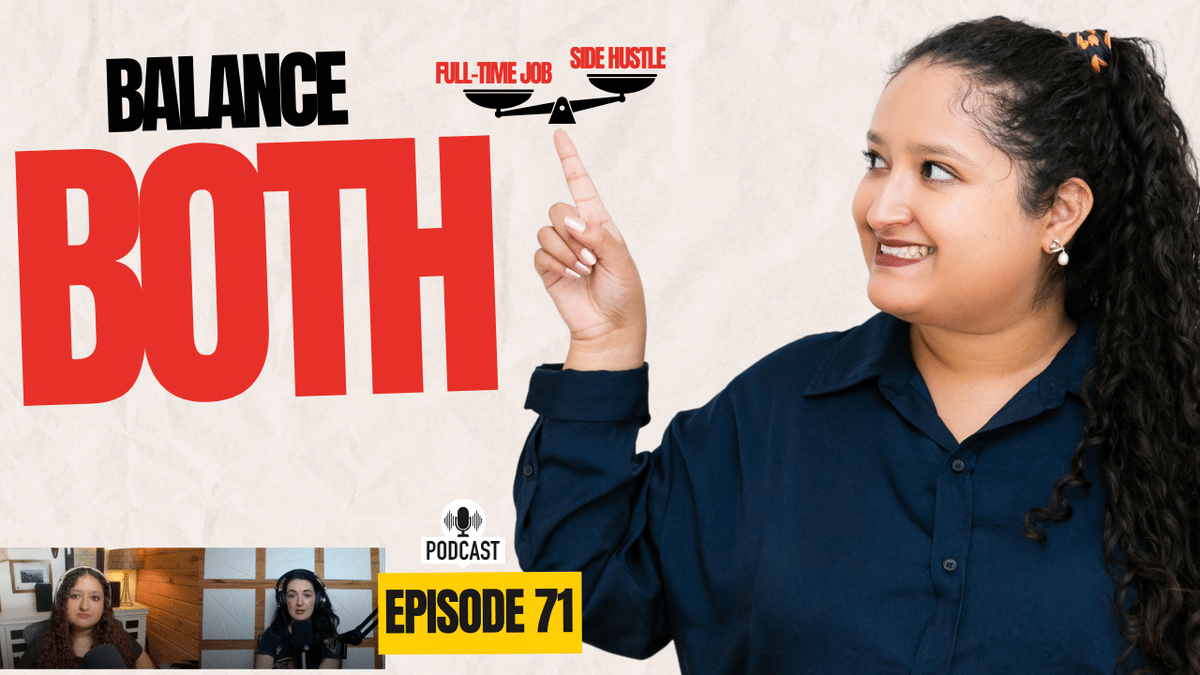
Vivian:
This topic is very near and dear to my heart because I'm still in the midst of it. So y 'all are in good company, but it is for anybody who is currently working a full -time job or a job. They want to start something on their own outside of that job. So a side hustle or a small business on top of it. And so we just wanna be here today to provide you some valuable information on how to kind of navigate through that because it can be overwhelming at times. And I think a lot of times just the idea of it prevents people from actually getting started on something that they're very passionate about and something they wanna do. I can tell you having done it now for seven years plus, it's doable you guys and you're building your dream. So I think it's, what is more worthy of putting your time and effort to than that?
Chelsea:
Yes. And as Vivian said, she is still in this process of navigating her full -time nine to five on top of The Seasoned Marketer. So luckily she brought me on. So I try to alleviate the pressure off of her, but I want to start this conversation by saying, y 'all, please be reasonable. Be reasonable about what you can do. You are one person. So let's be realistic about your goals for your business. Because if you're not realistic about your business goals, you're going to feel awful when you don't reach them. And we don't want you guys to feel awful. Running a small business is hard enough, period.
Vivian:
Trying to run a business on top of already having a full -time job is intense. So very important to track your wins because it's going to help you, it's going to motivate you, going to give you perspective, but be reasonable about what your goals are. Yeah, and I think what comes along with that, Chelsea, is organization. So what's kind of interesting is it's going to help you, it's going to motivate you, it's going to give you perspective. For me it's not nine to five, it's eight to five, okay? And then some on the weekends it just depends, right? Because it's a full -blown career, okay? So there are responsibilities that sometimes occur after those hours and all of that. So schedule from week to week can sometimes vary, but for the most part, when I was starting The Seasoned Marketer, what helped me was,
I was very structured and know that you can loosen up. Like I'm not as structured now as I was then, but it helped me to get things off the ground and to stay consistent. And what I did was I knew what time I had to be at work. And I knew that anytime before that and anytime after that, and maybe even during my lunch break, I could do what I wanted to do. And that's when I focused on building The Seasoned Marketer. It was before, after, or in that hour lunch. Now, what is interesting there is I was never particularly a morning person. It forced me to start waking up at 5:30 and getting stuff done early in the morning. And so, and I think even still now, Chelsea, like, you know that sometimes I'll be awake early to kind of try because you'll get like emails from before that eight o 'clock timeframe. So it does help to organize or get in a pattern of doing stuff. And that would be my one recommendation that I think goes hand in hand with what you just brought up.
Chelsea:
Yeah, and we've discussed this before, but consistency is your friend because not only will consistency be good for your audience, they enjoy seeing you consistently, but being consistent is going to help you become more efficient in whatever you are doing. And being consistent is kind of going to force you to stick to that schedule, right?
Vivian:
Yeah, it holds you liable, that's for sure, or accountable, not liable, holds you accountable. Because the thing is, to give you an idea, for The Seasoned Marketer, we're doing free resources in terms of like YouTube videos and also shooting a podcast. And so what my structure may look like is I have the weekends to film and edit those videos. Okay. Because those are two days, Saturday and Sunday that I have that are full days that I can do whatever I want.
Now in there, because I also try to be a family gal, I wanna hang out with my sister, my mom and dad, my husband do all that stuff. And I also need downtime to rest. So I have to be very, I have to think ahead as far as like, okay, I need to have my script done ideally by Friday. So that way Saturday I can shoot and that way I'm not having to sit there and try to write and do all this. Our weekly emails that we send out, right? That's something that we have to like, you know, think about and get out. So the structure helps very much, especially when you, to alleviate feeling the overwhelm. Because if it's too chaotic, you're bound to miss some deadlines that you're putting on yourself, okay? No one else is putting these deadlines on you, you are.
Chelsea:
I do also want to say small business owners, I know you're already so busy and you're working your full time job as well. And why would I sit down and create a marketing plan that's going to take so long? And is it even worth my time? Yes it is, because it's going to help you get more details. So you can be very clear with focus.
It's going to help you get organized so you can be very clear and focused on what you need to get done. However long your marketing plan is. We've had this discussion. You don't have to have a year long marketing plan. You can do a quarter. You can do six months, whatever works best for you. But having that marketing plan is going to help you be more efficient with all of the things that you need to get done with your small business. And we have an entire episode on marketing plans. So if you haven't listened to that, go listen to it.
Vivian:
Yeah, and what it does upfront is for one it forces you to think about what resources you have available right now. What budget, if any, that you have available right now and then also how you want to tackle building something from the ground up. Alright, so and for some people, depending on where they're at and what they're doing, it may be easier than others, but I can tell you that it helps because you are starting something from scratch on your own, you want to be sure that you have these quarterly focus so that way you can determine, like Chelsea said, if you've reached your goals, right? Because then that kind of gamifies it for you and it makes it fun. You're like, great, I see improvement. I'm reaching my goals on X, Y, and Z. Some of these goals may look different. If you're first starting out, your goal may simply be to hammer out what my actual business is gonna look like, what my revenue sources in my business is gonna look like.
Let's say for example, you're a knitter, okay? And you wanna start selling whatever you're knitting. One of these things that you would think through is, all right, do I want to sell on Etsy? Do I want to sell on my own website using Shopify? Do I want to exclusively use markets to sell my products? Like, you know, these are all very different marketing initiatives that would require different things from you. So once you identify in, let's say first you're like, hey, I'm gonna start on Etsy because it is the easiest place. I just have to, you know, take photos of my products and then I can upload them and write the descriptions and then I can start selling. Then, maybe the next thing I wanna do is I wanna create my own website, but I know that's gonna take me a little more time, all right? And I may have to hire somebody out for that. So how much is that gonna cost me? So you see what I'm saying? There are these things that I think it will help to give you, like you said, small wins that you can celebrate as you go along and then move your business forward into that growth stage.
Chelsea:
Yeah. And is this how your business is going to pan out? Probably not. But try right now. I'm thinking about the conversation we've had, we had with Michelle from Vision Bomb, how, okay, she tried to do a plan. It just didn't work. Like she was just all over the place. It ended up working out for her. That's great. I don't suggest doing that. I suggest trying to create a plan just because it's going to keep you continuously moving forward.
Vivian:
Y'all, these are real hard conversations that you have to ask yourself. If you're wondering why Vivian Walton is still working a full -time job seven years into this, if you're thinking, well, why hasn't she launched? There's a lot of stuff that's like going on with it and you have to do what is best for you, your family and your business. And for me, the most logical thing for me was - I'm not going to be able to go full blown into doing this year four into it, but I can hire my sister to help alleviate a lot of what I'm doing in that way. She's dedicated to certain things, initiatives that are going to help the business grow. Then I'm still on my track, right? It just looks different. So you're constantly having to reassess - for Michelle I remember she had talked about how okay, she was doing it and then she said need to go back to working my engineering job in maybe a different capacity, but still doing that. Small business ownership is not linear, y 'all. The good thing is that you have options. You have options to be doing that. For us, I think for me personally, the nice thing is that this is a source of creativity.
And also it's us building the business up and being able to become that marketing hub for people. I enjoy spending my time doing that. Eventually that'll be the full time thing. It's just not right now. And that's fine because I understand it's going to be, you know, something that, that grows over time.
If you have an idea or you want to do something and you just haven't done it because you're too scared, this is wonderful. You don't have to quit a job to start a business. Keep your job, work and grow your small business while you can when you have the time to do it. And then that way the leap isn't as scary.
Chelsea:
Yeah. I mean, here's the thing. Is it going to be hard? Like, I'm not going to lie to you. It's not going to be easy. But if you reassess, like Michelle did, she took a step back and she said, you know what, I need to go back, get at least a part time job. She did what was best for her.
Vivian:
Yeah, and I think the burnout part of it is a really big deal. So what ends up happening sometimes is maybe you have an idea and you work at it for like three, four months, six months, and you're not seeing traction. And then you're like, gosh, what am I doing? I think Chelsea had mentioned earlier about being realistic about goals.
You're not going to build a business in six months, y 'all. Or listen, if you have a really great idea, there are some of these tech companies that do that, but a lot of times they have investors, they have capital. And so that's the thing is just remember that depending on what resources you have available to you, you may not be able to scale that quickly. You may not be able to go from zero to 100 in six months. That's okay. All right? It takes people a while to get there at times.
Interestingly enough, was one of the favorite people, my favorite people to follow on Instagram is Sarah Blakely. For those of you that do not know who Sarah Blakely is, she is the inventor of Spanx. Okay. And she posted something today that kind of caught my attention and it said, it's only delusional until it works. And then the second picture she uploaded was the first prototype of what Spanx looked like. And this thing does not look anywhere like the Spanx of today. This was her first like couple of prototypes. And when she started and she said that at the bottom, because they're footless, they're not supposed to be pantyhose. At the bottom, they're open ended. And so she would iron the bottom of it because when she would get them in, they wouldn't be, they would just kind of look all whatever, wrinkly.
But then Oprah caught ahold of one of these and she loved it, had her on there and then her sales skyrocketed, okay? So my thing is this, if you have an idea and you feel passionate about it, I think it's worth it for you guys to give it time to work, all right? Don't go into it thinking that hey, in my first year, I'm gonna make $250 ,000 and I'm gonna be able to quit my job. That happens sometimes for a very select few people. And sometimes you don't know how much capital they have behind them or what their family life is like. Maybe they're married to a very successful husband that, basically they don't need a job or something. Y 'all don't know anything outside of that. So just don't be comparing yourself. But I do think the burnout is real and it can really hinder people. So Chelsea, what tips do we want to give them about burnout?
Chelsea:
Yeah. I want to start this conversation by saying I am so sick of hustler mentality. Okay. I am so sick of the you always need to be on, you always need to be selling, you always need to be working.
It's not healthy. Okay. That is not something that your body can handle.
Vivian:
Yeah, I don't understand people like that. And the hustle mentality is always interesting to me. I will say this, I think because I'm older, Chelsea, I let people be. You want to spend your entire life hustling away and not prioritizing relationships and doing fun things and doing that. For some people, that's their jam. They love building businesses and working all the time. Fine. If it stresses you out, affects your health and you're okay with it, who am I to tell you otherwise? Okay.
If it works for some people, if it doesn't work for you, that is fine. You don't have to do it. You don't always have to do it. Your brain is free. So when you feel yourself burning out, that's when you start to make mistakes, right? The quality of your work, the quality of your life, it comes down. So let's not let ourselves get burnt out.
If your body is telling you you need a break, listen to it.
Vivian:
There's also a lot of studies out there that prove that in order to be creative, you need to rest. so that's an important part of the creativity process. So if you guys are doing any type of creative work, then just keep that in mind. Integrate downtime into that process so that way you can continue to be creative in the way that you need to be. And what I'm thinking of specifically is let's say that you're doing like, I don't know, you're wanting to do videos or movies or stuff like that. If you're doing any type of writing, all of that, it's very important to include play in a lot of that too, because that does spark creativity as well.
So the work -life balance, work - life - side hustle balance, okay? That's, yeah, it's not a two scale, that's like three scale thing. But you do wanna give it adequate consideration because you never want to be working all the time and then have your relationships or just, you know, your life in general suffering over that.
Give yourself time to re -enlighten yourself. Yeah, re -enlightening is always super important. you guys, it's different for everybody. Okay? The stuff that excites me is going to be different than the stuff that excites Chelsea. Trust me. Okay? That is just something we know. you know, so we can't tell you exactly what that is, but we can say whatever that spark is, whatever allows you to feel relaxed. If it's fishing for you. Some of you may be going to the beach. For some of you, it may be going and having a great meal with friends, right? Others, it might be time with family. For some people, it's actually exercise. So if you have to incorporate exercise into your daily routine, your weekly routine, in order for you to feel good and to allow you to get the work done and remain creative.
Chelsea:
I love that guys. If you're feeling stressed out, if you're feeling like you don't know what you're doing, if you're feeling like, my God, doing a side hustle, being a small business owner is awful. And I'm struggling right now. You can reach out to us. We're going to listen and we'll tell you, Hey, you know, you're going through this right now. Vivian went through that too. Here's how Vivian dealt with it. You don't have to deal with it like Vivian did, but here's some suggestions.
Vivian:
I think a lot of the times too, Chelsea, and trust me, this is not ever, I've had these instances all the time too. I think sometimes when we don't get, grow as quickly as we want, or maybe we're like, is this not working out the way I thought it was? Like, it looks like it's easy for everybody else and it's so hard for me. We have a tendency to wanna scrap stuff and start over.
Okay, because that's very, and in some cases you should maybe, okay? But in other cases, it may be more of a soft pivot or it may be, so I try really hard when I get in these moods of like, I'm like, hmm, like I just, you know, I want this to be a little different. Instead of deconstructing and blowing the whole thing up, which is what I'm telling myself to do.
Chelsea:
Sometimes you just need to talk it out. I am that person to Vivian. Vivian is that person to me.
It can be a significant other. Tim does not want to hear anything that he's not interested in. Whatever. That's fine. If you don't have anyone again, you can talk to us. That's fine. We will listen. We understand. But finding someone who will give you their opinion, who will listen to what you're saying. Sometimes you just need them to listen again. Finding a person who will be that for you is very important.
Vivian:
is very important. And I think if you don't have any person in your life that can do that, what would be a good substitute or a good addition to that is find community. Find, okay, so I'm a part of Charleston Women in Business. It's a closed Facebook group for the Charleston area, you know, women that are trying to run their business. It is a wonderful community because in there you see people asking questions. You see they're promoting their stuff, but it's also a place where if I had, if I was like, I just have this idea and I just don't know like what I could easily just post it on there. But I think it also puts you in this, in this like space where if you guys, let me just say this to you. If you guys are launching a side hustle or a small business, your family and friends may not get it. And that's okay.
Just keep doing you!
Vendor Market Red Flags: Do NOT ignore these!
Vendor markets can be a goldmine for small businesses - OR a total waste of your time, money, and inventory. Over the years, we've learned there are a few red flags you can look for to help you determine whether participating in a specific fair, pop-up, craft show, farmers market or community event ...