
Vivian:
Hello, business friends. Welcome to another episode of our SOB Marketing Podcast. SOB as in small business. We're not out here calling you guys names. So just as a friendly reminder, we do drop a new episode every Thursday. If you are not already subscribed, please go ahead and do so. So that way you could get a notification every time a new episode drops. Also, if you want to go back and take a look at our library of episodes, we have a website, sobmarketing .com.
where you can find all of those episodes there. And today, I think you guys are really gonna enjoy this conversation. So Chelsea, why don't you tell us what we're doing today and why it's so special?
Chelsea:
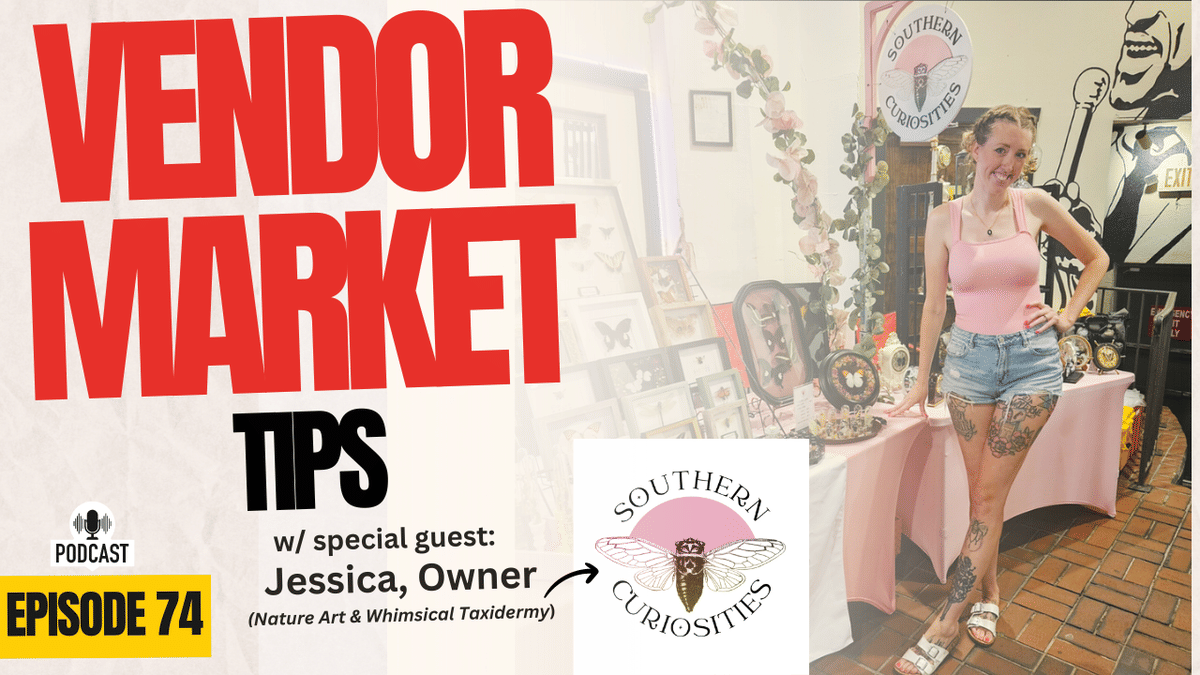
Okay, we have a really exciting episode for you guys today because we have a special guest, Miss Jessica Shoemaker from Southern Curiosities. So Southern Curiosities is an entomology, art and whimsical taxidermy business. If you guys have never been to Yalmar, if you're not here in the low country and you've never experienced the eclectic market scene here, then you might not know her. But if you have, then you know Southern Curiosities.
And I want to say, Jessica, I love your taxidermy. It's so good. Yeah. And my best friend, Bree, does not listen to this. She doesn't listen to my podcast, which is fine. That's fine. Perfect. Because right now she's in vet school. When she graduates, I plan on getting her one of your mice because she loves the mice.
Jessica:
my God, thank you. Really? I love the mice too. Thank you.
Chelsea:
They're so cute. And I'll add a picture on our Instagram and stuff like that so people can see it. But these are the cutest little, I mean, I don't even, I'm trying to think, ooh, the mouse on the toilet. She loves that one.
Jessica:
His name is John. I'm so glad that I can just bring a little bit of joy.
Chelsea:
Give us some backstory, give us a little more detail about Southern Curiosities and what it is as a brand.
Jessica:
Absolutely. So Southern Curiosities, like you said, it's entomology art. So I call it all encompassing nature art and whimsical taxidermy because I don't typically do like a standard museum style taxidermy. I try to go more like a storybook. I want it to kind of take you to a place that kind of hits you in the fields. And
You know, I'm a Disney addict, so anything that looks like it can come out of a Disney movie makes me happy, and I hope it makes other people happy.
Vivian:
No, you're fine. Well, let me just interject here and say, interestingly, when we moved out to the country, we're out here in little Bono, South Carolina, and it's a legit cabin that we live in. When we toured this house to consider purchasing it, the gentleman that lived here was a big hunter. And so he had a ton of deer heads and taxidermy in his living room. And I remember when the first time I saw it was like, that's interesting. He even had like a coffee table that had like a little fawn in it or something and a snake. It was intense. There was a lot of stuff going on, but here's what's interesting is I love that you just said you're, you're doing a take on that, but your take is considerably different. Like it's not what people would, you know, would think about because if you are a hunter, you're like, okay, I know what that looks like. No, y 'all have not seen what Jessica can do.
Jessica:
Yeah, if your rat's not on a stripper pole, it's not quite the same vibe as what I'm doing. But, you know, it's often, I have that conversation often when I'm at markets because a lot of people have a preconception of what taxidermy is and that it's always hunters and trappers and that it's, you know, a trophy, if you will. And that's great, especially when somebody is using the full animal. I am all for it.
It's incredibly important to our ecosystem for hunters. So I am not against it whatsoever. However, I kind of prefer to take it on a little bit of a different path to where all of the animals that I work with all died natural deaths. So I always tell people like they were dead when we met. didn't, I don't go around bopping mice on the head.
I mean, it's really funny how many people are like, my God, did you kill all of these? And I'm like, absolutely not. They all passed naturally. it's very, I mean, it's just a little, I'm like, do you really think I'm that weird? Like, thank you, but, and so, you know, it's, I'm, it's a very intimate process. Yeah, because, you know, it's very all encompassing when you're really like working with this animal. But then, you know, when it looks back at you, when you're all done with it, it just brings me so much joy and I could not love it more. And the joy it brings other people or the memories it brings people. I mean, when you can hit on an emotional factor, I mean, it's a game changer. So I'm fortunate that I have such an incredible amount of like farmers that reached out to me that gave me any of their misfortune.
failure to thrive animals, because it's an unfortunate part of farming. So I want to make sure that I know the farmers, I go to the farms, I meet the people, I hear the stories so that I know what I'm working with and that it's a harmonious relationship between me and nature and those that care for the animals. it's, I think it makes a difference to my customers as well when they know that I care about these animals as well.
Vivian:
You said something earlier. Do people really think I'm that weird? So let me ask you, do you have blue or green eyes or brown? Okay. So blue eyed, blonde haired, beautiful young lady, how do you end up getting into taxidermy? Cause like you said, you would be like the least person I would pick out of a group to be like, yes, she does taxidermy, right?
Jessica:
They're blue.
Well, it's funny because my husband helps me at all the markets and he's, you know, fully tattooed. He's a tattoo artist. And so they're just like, they talk to him, like he's the one that does it. He's like, I don't touch these things. Like I would not help her with this stuff. But my parents always get asked that too. Like, how did she start doing this? This was kind of weird, but I've just always been, I grew up in the upper pennants, and I love Michigan. And if you're familiar with that area of the world, it is just nature. Like I tell people I grew up in the woods. So I grew up with a lot of like Native American history and going to powwows and just really feeling a special feeling with nature for one. And so my husband and I were always just collecting entomology frames from tattoo conventions or taxidermy or when we would go on walks with our dog we would find like deceased butterflies and stuff and we would just like set them on a shelf or put them in a Pringles can and
It got to the point where I was just like, mean, they could, we have butterflies in frames. There's a way to do it. So like, surely I can figure that out. So I just fell down the rabbit hole of self -teaching myself how to pin insects. And I started with that and it was just for fun. And I had friends and neighbors that were like, my God, I want one. And so was like, I mean, okay. And so I started with this little bee in a jar, my little mini bee jars, and people went bananas.
And I was like, well, OK, I guess I'll just like to do Etsy or something and I'll just throw a couple on there and see how it goes. like people bought them. And I was just like, wow, how cool. And then it was just kind of like a natural progression where I actually went to an oddities expo and they had a taxidermy class for a two headed duckling. And I was like, OK, fun, I'll do that.
And I'll be honest, it was a little bit jarring at first because even though you know you're gonna be dealing with the skin of an animal, you're still not ready for it until you actually do it. But it was this weird light bulb that went off where I was like, my God, this is literally everything I love about art. I've been an artist my entire life. Like I love art, I love crafts. And so was like, my God, I get to mold, I get to do.
like 3D dioramas, get to do sewing, I get to work with nature. And I was just like, my life just changed, like this is it.
Vivian:
And I think that's where we're having the conversation today, right? It's like, think you just, your awe in finding people that actually wanted to purchase this stuff. And you're like, I'm just tinkering with this, like, you know, doing my thing. And then they're asking about it. They're wanting me to create something for them. So I think that's where in markets we find that, you know, we always think like, great, I'm going to go set up a table, set up an exhibit, set up a booth.
but will anybody want my product or my service? And so I think that's where today the conversation is gonna be about, how do you go about finding that right audience? Because I mean, listen, if you can find it, if you can find it for little mice on stripper poles, then I think everybody out there can find their right target audience.
Jessica:
Absolutely. And that actually all started like I was a marketing manager for a Harley Davidson dealership for 15 years. Great job, taught me a lot, grateful for all of that. But then I had a coworker at the time that was selling like the multi -level marketing or know, type thing. And she just kept being like, my gosh, you need to like go to a market and sell yourself. was like, no.
I'm not on that level. I like selling bee jars on Etsy. We're not there. plus I worked Tuesday through Saturday. Saturdays were mandatory. It was our busiest writing day and every market fell on a Saturday. I was like, this is not going to happen. And then Yallmart came about. Bless Yallmart. If it wasn't for them, I would not be who I am, where I am because we started at the same time and we've grown together.
They put a post on Instagram and they actually reached out to me and they're like, hey, would you be interested in vending at our first market? And it was on a Sunday. And then it was at New Brooklyn Tavern at the time, which if you're familiar with the Columbia music scene, like I grew up at New Brooklyn. Like I had such a special place in my heart that I was just like, name, Yallmart at New Brooklyn, it's a weird market. They asked me like, the stars have aligned, things are happening.
And after I did that first market, everything changed for me. I realized that there were people that appreciated what I did. They paid their hard earned money to buy it, which alone is just amazing. then, you know, just growing the audience, they grew their audience, which in turn also grew mine and we have grown together and
I love the market community and being a part of it and finding my people for the first time. Well, I don't want to say it for the first time in my life, but in my adult life, like finding where I belong and never being as happy as I am right now. I highly recommend five out of five stars.
Chelsea:
Yeah, Jessica, I'm going to say I am right there with you. When I found Yallmart, now I'm not a vendor. I don't have anything. I'm just there to spend my money. It was finding that community of people who are not afraid to have rats on a stripper pole and who are not afraid to go out there and sell their studded leather corsets and stuff like that. Like finding those people when, I don't know, kind of, grew up kind of weird. Okay. Like people thought I was weird. People still think that I'm weird and that's perfectly fine.
Jessica:
My favorite people in the world are the weird people.
Chelsea:
The point is that there are still people out there for you, not just, you know, personally, but also as a brand and as a business, you just need to find where they are.
Jessica:
Absolutely. And they're out there. it's surprising how large of a community there is when you're not like a part of it you don't see it you don't know about it. But once you're in it and you know about it, it is amazing. Like how many people are weirdos? They're the best.
Vivian:
Well, so let me ask you a kind of like a personal question to that because I know we had we had talked about the fact prior to that you so you were working for Harley Davidson in a marketing role and so you already came to the table with a little bit of knowledge as far as like, hey, I kind of know what I would need to do to to sell my products, but you still didn't take that leap until COVID kind of came in and pushed you and you and your husband had a conversation and then you decided maybe I want to do this full time. So what would you say to someone who as a small business owner, they're tinkering with stuff and they're thinking, can I make that leap? Should I make that leap? Like what was your decision making process?
Jessica:
So I think it's a little different for everybody. I know that there are some people that are okay with just jumping with both feet in and I commend them for that. I however am a mega planner and I need to know every outcome, every situation. So I actually, yes, my husband and I got COVID and it was a pretty gnarly case of COVID. We got it for Christmas of 2022. And I had been unhappy at my job for a while. I was also, the more Yallmarts I attended at that point, that was the only market that I was attending.
And the amount of people that were coming to see me that were purchasing my stuff, selling me out almost every single time. It just kept pulling me harder and harder in that direction. And it's something that I love so much. And it gives me so much happiness and joy that I would, you know, come to work. And that's all I could talk about. It's all I could think about. I would work on it a little, I remember doing this like a cowboy rat and I was up at the counter, like making a little belt for him. And my boss was like, what are you doing? I was like, working. But, you know, I only had so many hours in the day to try to make enough inventory for the next market. And so it was pulling me harder that way already. And so when we get really sick, we always end up having our best conversations when we're both ill or when one of us is in a dire situation.
Vivian:
I think that's how it goes.
Jessica:
So we're like dying on the couch and we were going for a walk every day sometimes only to the stop sign and back and I told him, they're all but upset that I'm not at work right now because I have COVID. And I just don't feel like they care about me. And I'm putting so much effort and so much time into trying to grow their business. I could be putting all of those eggs in my own basket. So I think it might be time that I try it. I mean, we don't have kids.
You know, we're at a place financially where I feel like this is the time that maybe I can try it. And he has been 100 % supportive from day one. He's, I can't say enough amazing, wonderful things about my husband. He's the best ever. Yeah, he works the markets. He does all my woodworking. He took up 3D printing just so he can make me tea cups for my rats. And he taught himself CAD programs. He's incredible.
Vivian:
I mean, he does work the markets with you. That by itself says everything.
Jessica:
He also has done so many tattoo conventions that he knew what I needed to do going into the markets. So he was like, you're going to need this. You're going to need a wagon. This is how you need to set up. You need to have a banner. You need to have business cards. So he set me up for success because he already knew what I needed. And so he pushes me to be the best version of myself. And if it wasn't for him, I also would not be where I am. So like, bless him. He's the best.
Chelsea:
Where did you find these other markets and how did you decide that they were worth your time? Because again, like this is a very specific type of business that you have.
Jessica:
You know, I'll be honest, it's trial and error for one. Just trying new ones because once I did go full time, that's where I was going. We had COVID, and made the decision. But before I even put in my notice, I had my LLC, I had my business bank account, I figured out how I was gonna pay myself, all of those things. And then I put in my notice so that way I could hit the ground running when I quit. And the weekend after I quit, I already had the Artists Vista market lined up and others.
I did like the Lexington Ice House amphitheater markets, just a handful around town because I was like, now's the time for me to try these Saturday markets that I've not ever been able to do. And some worked out better than others, but I will say everybody wants to put me in this category of oddities and curiosities. That doesn't mean that I necessarily do well at those because it's a saturated market. I'm surrounded by other taxidermists, other
Butterfly frames. So how do you stand out? I actually find that I do really well at markets that are not even oddity related and it gives me the opportunity to talk to new customers Open their eyes about this world and have that whole conversation about where I get my specimens from my ethics and morals behind how I do my art and
they become like taxidermy lovers overnight. They had no idea that they wanted, you know, a mouse drinking out of a mushroom cup, you know? And then at the end of the day, they're like, my God, I can't live without it.
Vivian:
I just want to tell everybody here, you cannot listen to this episode and not go to her Instagram page. Okay. So Southern curiosities go to her Instagram page because all of her, she puts all of the specimens, all of the projects that you do are on there. And I can tell you when you, you know, you hear her describing them right now, the, know, the mouse on a motorcycle and all of that. It's just as cute in person.
Jessica:
Right. it's also with any art, when you don't know what goes into it, sometimes you don't see the value in it. And so, you know, sometimes people might see my price points and be like, my God, why would you charge that much? It's, you know, a frame that you thrifted and, you know, you just glued a butterfly in it. I'm like, it may seem that easy, but you have to find the sustainable butterfly farmers where you can get butterflies from other countries, then you have to pin them, which is a whole process in itself. And then you go to the thrift store to find the frames, you clean the frame, refurbish it. My husband 3D prints the background, you buy the back. It can sometimes be a weeks process just to put a butterfly in a frame. And I think when people see how that's done, or even in the taxidermy side, I don't like to show too much because it's a little too much for some people. They might not have the stomach to understand what goes into it, but I think they respect it a little bit more and they understand how much time, love and passion goes into it. And I think it kind of makes them realize, you know, that it's not easy. And again, how much love I put into this stuff as well.
Vivian:
Well, and I think you also tell the story of animals too. The one that I thought was interesting was you had one on a possum and it was a mama possum. But so the babies in your caption, I read the whole thing and I was like, this is why people love it. It's because you're telling the story of the possum where you're like, Hey, this is a mama possum. She had babies. The babies are thriving. She unfortunately did not make it through though. So I think that's where, you know, we're getting to see an aspect.
Jessica:
A lot of people think I'm glorifying death and I like to think that I'm glorifying the life that they lived because like every living being it deserves love and it has a whole life that it lived. It has a story and I think that's important to tell. I just recently got the opportunity to work on a small little baby fox and it was a good opportunity for me to educate people about pesticides because the mother ate pesticide and then fed her babies and all of them unfortunately did not make it. And I was given the opportunity to preserve the beauty of this little baby fox, baby boy. And I think it's a good opportunity to not only again preserve his beauty and show everybody how ridiculously adorable this little baby fox is. Getting to work with something like that up close and personal. And then also, you know, taking some of those proceeds and donating them back to a local wildlife rescue center to educate people on how to care for wildlife that is injured. I'm not out here killing them. We want to promote saving them.
I don't like getting phone calls from farmers that say that their goat passed away and you know she's crying on the phone because it was her favorite but she doesn't she just wants it to go she wants somebody else to love it as much as she has loved it so that is an honor in itself and it really means a lot to me.
Vivian:
As a wife to a, apparently now I have a chicken farmer for a husband. He loves his chickens. We have like over 70 something chickens, Jess. It's crazy. Yeah. And so he, there's one in particular though, he saved from a fox. She was about to die. He nursed her back and they are like, that's his little girlfriend. Her name is Gigi. We just got pictures taken, professional pictures taken. Gigi was in it.
Yeah, it's a personal connection and I don't, I don't know why we would think anything otherwise when I mean, I have two dogs and I love them as if they were, you know, people. I think you do get attached to any animal no matter what, right? People do that with snakes and all of that.
Jessica:
It's funny. My mom actually made an interesting call the other day when she saw that I was working on this goat. And she said, hey, I'm just checking on you to make sure that, you know, you're feeling OK and that you're like mentally in a good place because I know you're sensitive. I just want to make sure that you're like, OK. And I was like, absolutely, mom, you need to realize that I'm treating this as I would any living being that I've ever gotten the chance to work with. The mouse to the rat to the bunny to the possum to this goat - like they all hit me in the heart. I hate that any of them are gone but they all matter to me you know regardless of size. She's like okay well just checking. I was like, thanks mom.
Chelsea:
I want to go back and talk about the fact that you said that some of your most successful markets are the ones that don't focus on, you know, eclectic and oddities, curiosities. What do you consider a successful market? Because, you know, every small business is going to consider success, it's going to be different. So what for you is a successful market?
Jessica:
I think what makes a successful market is, I mean, obviously the profit at the end of the day always makes for a great market day. So that's great. But I also think being able to make new connections and meet new people and even start conversations, like I said before, about opening people's minds to what I do, if they don't buy that day.
But they come back to another market or they start following me on my social media so that they can see where I'm gonna be at in the future. That to me is success. I've had some markets where I don't necessarily come home with the dollar amount that I set as my goal for the day, but all my business cards are gone. I had really great conversations. Somebody talked to me about a special order, which I do all year round by the way on my website.
So even if it's not financially the best, if it is a well -run market, the communication is great between the coordinators and the vendors. It has a great layout for how people can shop. It has people that are volunteers to help unload your car if parking is good. There's so many things that can actually make me have a great market experience. And it may not necessarily be financially as great as like, Yalllmart is always going to be my standard. And I would love for every market to be that, but they're just their own entity. Sometimes, markets don’t blow me away, but the conversations I had, the connections I made, the other vendors that I've met and then having a well run market.
When a coordinator can put together a well -run market, what a game changer. Like that can make a great day.
Vivian:
I think the thing that stood out to me just now was, Jessica said she has a website that she's able to send people to that she takes custom work throughout the entire year.
She's utilizing a solid Instagram profile, but you are not just relying on Instagram to put your product in front of people. When you're at these markets, you're also telling them like, Hey, here's my business card that has my website on it. So no matter what, you can always connect with me, right?
Jessica:
Right, yeah. And that's another thing my husband's always in my ear, "give him a card, give him a card". And I'm like, yeah, yeah, yeah. Because I'll just have a full blown conversation, be like, So he's really good at keeping me on track and remembering to promote myself. But that was another benefit of me doing marketing for so long is I don't rely on the market to do the advertising for me.
Of course, I check out their social media, their websites, and see how many followers they have and how much interaction they have when deciding if I'm going to do a market or not. But sometimes even the new ones that are fresh have been really successful. But I also, I only rely on myself and I try my best to promote the crap out of myself and where I'm going to be. This is where you're going to find me. And I post every single day while I'm eating breakfast. I make a post. I have a catalog of photos and I just make sure this is where you can find this particular rat. This is where you're going to find it.
And I have found that when you're sick of hearing it, other people are just now catching on or they're just now reading it. So as much as you know, we're like, my God, how many times are you going to post about, you know, the punk flea market or whatever?
Until everybody sees it, until they know I'm gonna be there.
Chelsea:
Absolutely. Y 'all listening. I want to hit some points. She said, even if you're a broken record, keep saying the same message because that's going to be the first time someone's heard you. And then also post communication, this I'm, I'm like heated right now, not like angry, but I believe so much in post communication because even if, like you said earlier, even if you're not making those sales,
If you made a connection and found a way to lead them to your website, to your products, that's still a connection. That's still someone who might make a purchase. It was still successful as long as you're doing that post communication and actually bothering to build a community and to create a relationship.
Vivian:
Now the statistics are it takes seven to eight touch points for someone to finally buy from you. That means if you're just getting to meet someone, I come up to your table and I'm like, wow, I did not know this business existed. We had a good conversation. I leave with your card.
Yeah, maybe I didn't buy from you that first time, but the next time I see you at a market or in Chelsea's case, when she has Christmas coming up or she's got a graduation present she needs and it's fitting for the person that she's looking for. She's like, I know someone that can, that I'm going to go to for that. So I think that's the interesting part is business owners don't think that just because they didn't purchase from you once that you've missed an opportunity.
Jessica:
It was very similar in the motorcycle industry as well. And I think that's why I'm okay with people coming to my table and learning what I do, falling in love with it and leaving. Like that's okay. Because when I was at Harley, I also was in the motor clothes department, which so I did like helmets and leather jackets. These are really large, expensive purchases. Most people can love it so much, but that doesn't mean that they can afford it today, or they need to think about it.
It's the same with motorcycles too. You come in a few times, you try it on a few times, you make sure that it's something you really want to spend your money on. And so I'm not just selling my product, I'm also selling myself. And so I want to let them know thank you for enjoying my product. Thank you for telling me how much it means to you. Thank you for giving me the compliments because sometimes that's the best part of my day is when somebody tells me that it brings them joy or reminds them of their grandmother or their grandfather had this weird raccoon, something. And having those personal connections, I think is just one of the best parts about being alive in general. Markets are just so different from working in a normal retail store too. I'm selling myself and my product and something that I love.
Chelsea:
What I love about this conversation too is, okay, entomology art, whimsical taxidermy, people listening might be like, that sounds like a really hard business to find your people, but you know what? You found your people. And not only that, but listening to you talk right now, you are also actively bringing people in and actively building that community.
Which is so important for small business owners specifically because what you're selling is you, not just your products. It is you.
Chelsea:
Because we are talking about community and how important that is for markets, how often do people recognize you? How often do you recognize them? I know for me, like when I go to the Feminist Magic Market, not as much with Yallmart because I do live in Charleston, so I can't go to every Yallmart, but specifically for Feminist Magic, at this point I know most of these people.
Jessica:
So obviously the more you go there there's as much as there's a ton of local vendors, it's also a small community in itself. And so we all have come to get to know each other. And I have made some of my best friends now as fellow vendors because they're my people, because we're living similar lifestyles. You want to do art. We want to sell our art and we're willing to hustle in the heat under a tent. So obviously the vendor community itself, we all kind of recognize each other now.
And then customers, I'm so fortunate because my customer base is growing and they do recognize me. Fun story, I actually vended at this farm called Monarch Ranch out in Bamburg, South Carolina. It's a beautiful butterfly conservatory. I also highly recommend checking them out. But they had this market and there was a gentleman selling plants and I think he had some baked goods and stuff. And we hit it off immediately. We're just like, my God, you're my people. We clicked. And he was telling me about his husband and their business that they owned called Three Saucers. It's like a deli plant shop. And so actually when I went to pick up this goat, it was out in that area and I was driving by and I saw it I was like, my God, I need to stop in.
So I walked in and the guy that I had met at the market was not there. And so the gentleman behind the counter and I was like, Hey, so I met this guy at Monarch Ranch and he works here. He's like, my God, that's my husband. my God. Are you Southern curiosities? And I was like, yes, I am. You must be the husband. And so we just like immediately hit it off and he gave me a full tour and samples of chicken salad.
It was amazing. And I was like, this little itty bitty town in BFE, South Carolina, this guy's just like, my God, are you Southern Curiosities? And I was like, Yes, I am. So he gave me a paper for a market that they're attending that they'd like me to go to Orangeburg, I think. And I was just crazy. And we all help each other, which is another way I find other markets. Through Instagram messages and people just being like, hey, have you all seen this? You should apply. Or people will directly message me a market and be like, I think this would be a great fit for you.
It's amazing when you start to do what you love, you find the people that you love. And I've always preached that, but it wasn't until I really took this venture that I really, again, found my people, not just in fellow vendors, but also customers, repeat customers, people who have full blown collections of my things that, I mean, my heart could not be any bigger for all of these people.
Also, you're always gonna want somebody to watch your booth when you have to go to the bathroom or when you wanna get food. And so highly recommended for that reason. And then when you start, of course you're gonna be new to it. You're not gonna know what you need, but you figure it out. I realized I needed a dolly. It's easier to carry my tables from a parking lot two blocks away because they have crazy parking at this particular market.
You want a wagon and get a fan, y 'all. Get a battery powered fan. It is too hot down south to just be hanging out in the heat. Bottled water doesn't do it. But you learn these things. And so it took me one outdoor market in June for me to be like, I was angry. I was starting to get mouthy. My husband's like, you need to go in the car and pull down. And then come back. He's like, you need to wait 10 more minutes and then you can let it out.
Actually this year I took July off because I couldn't find an indoor market. was like, I'm not going to die this year. I just can't do it.
Vivian:
I've seen a lot more small business owners do that. Where they're saying like, hey, the heat is just too much for me. And so it's not worth it, not that it's not worth their time, but they just know like, hey, it's you, the amount of money I'm going to make and the amount I'm going to put my body through is just not worth it.
Vivian:
I hope if anything, this conversation reminds people that if you are a couple different things, if you are thinking of making that leap or you're like, Hey, right now I just can't make that transition. is a way. Sometimes, you know, Jessica, you did it like you are a planner. You had a game plan and you did, you executed on the game plan. And I think I appreciate that. Cause I'm very much like you. can't just go diving into stuff. I got bills to pay. Okay.
Jessica:
I knew I was going to have to have a conversation with my dad and he was going to have all the questions and I needed all of the answers before he even had them. So I was like, yes, I have a business license. Yes, I know how to do my taxes. Yes, I'm paying myself an income.
Luckily my dad knows that I'm like a super planner. I was expecting him to kind of be a little disappointed, especially because he's a big Harley guy. And I was like his daughter at the Harley shop, you know, and, but he was super supportive. knew I wouldn't be making a half assed decision really. Like he knew I was going to do it. And he comes to every single market, even if it's just to stand at my booth and show people pictures of the stuff I've made for him.
Vivian:
I love it. Well, so tell us what, is there anything that we miss that you would want somebody to leave this conversation with either about your business or about building a community?
Jessica:
Well, I think, again, if you find the things that you love, you'll find the people that also love that and there's your community. It's not as hard as it seems to be as you get older trying to make friends. And especially, I know one of you is an introvert, one is an extrovert. And sometimes it's hard to go out and meet people, but sometimes it's worth it. just, you know, whether you're a planner or whether you're not, just do it.
You know, make the leap. I highly recommend, you know, if you are a business and there is a market that you feel that you could benefit from, setting up a table and selling your product, try it. You might be surprised and either it'll flop and you'll just learn from it and you'll say, okay, well, this is what the people around me that I found to be successful are doing that I can implement. Or, you know, maybe this isn't for me.
And that's okay too. You can still love something and do it and not have to be a business. That's okay. But it might blow your mind and change your life, honestly. Cause in like in my life, it was one of those where I found something I love to do. People loved it. I have been able to grow and build my business and it's been amazing. And it was all because I decided to do that one market.
And here I am, you know, on a small business marketing podcast. Yay!
Vivian:
I love it. Yay. Well, so remind everybody where I highly recommend you guys check her out. I know you're on Instagram. Are you on Facebook?
Jessica:
I'm on Facebook, I am on Instagram and I have a TikTok. I'm not good at it. I'm trying because y 'all said to try other platforms. So I'm trying you guys. I am at Southern Curiosities on every platform. And I also have a website, southerncuriosities.com where I have an online shop. It's a little bit limited because my products take so long to make. I'm not able to fulfill an online store as well as having inventory for my markets. But I try to make everybody happy. And like we spoke about earlier, I do custom orders all year round. I'm always accepting them. And that can be bug art, insect art, could be taxidermy. I'm happy to have the conversation to start it to create a one of a kind piece for people. And I also have all of my upcoming events on my website. So you can shop in person.
Currently, I'm kind of staying in the South Carolina area, but I am doing my first tattoo convention in Atlanta at the end of September with my husband because he's again, he's a tattoo artist. So their whole shop is going to be there and I get to participate and sell tatty ratties while he tattoos people.
Vivian:
Taddy Raddies, what are Taddy Raddies?
Jessica:
They are rats with tattoo machines in their hands that my husband custom designed specifically off of one of his machines. So other artists will know like it's a Puck or Rollins tattoo machine that he's holding. And he makes these like wooden open dioramas. And then I put like tattoo flash on the walls and they're sitting in a little stool with a little tattoo machine. So hopefully a bunch of artists. My goal is to have a piece of mind in every tattoo shop in the state would really be ideal.
Vivian:
My gosh, I love it. When are we gonna be able to see a picture of this on your Instagram?
Jessica:
I have some tatty ratties if you scroll down far enough.
Vivian:
Okay. I'll go there and look at them later. I dig this idea. Well, introduce yourself to Jessica. We obviously love having you here and thanks for sharing all of that great information. You can find Jessica on social media at @southerncuriosities and their website is https://www.southerncuriosities.com/.
Do You Really Want to Be the Face of Your Business?
If you’ve ever felt the pressure to be the face of your business, constantly creating content, sharing your life, and putting yourself out there, this episode is for you. We dig into the personal brand vs. logo-led brand debate and the bigger question behind it: What kind of business do you actually...
Is Your Business Showing Up on ChatGPT or other AI Chatbots? Here's How to Find Out
Even if you personally aren't a fan of AI Chatbots like ChatGPT, Claude, or Grok - you WANT your small business to get recommended in their search results because that can lead to more sales. But how do you even start to measure your AI "visibility"? In this episode, we share a four-lens framework f...
Google Search Console Is Changing: What Small Business Owners Need to Know in 2026
Google Search Console just got a lot more interesting for small business owners. Google is giving businesses new insight into how their content shows up across search and that includes the growing connection between your website, social media content, and the way people discover you in search. In th...
Why Should Anyone Shop with You on Small Business Saturday?
Small Business Saturday is a fabulous opportunity to increase your sales, but it's not enough to ask people to shop with you just because you're a small business! In this episode, we share questions you can ask to help you identify what makes your product, service, or experience different and how yo...
Small Business Saturday is Coming - Are You Ready?
There is MONEY to be made on Small Business Saturday! Estimates are that around 62.7 million people shop in-store and about 63 million people shop online. While this episode was originally shared in 2023, the strategies we share to increase sales during this small business specific holiday are more ...
What To Do When People Ask Your Business for Free Stuff
Small business owners get asked for free donations all the time from non-profits, event-organizers, influencers, and even family and friends - but when (if ever) does it make sense to actually say YES? In this episode, we discuss how to approach requests for free stuff from a marketing perspective a...
Vendor Market Red Flags: Do NOT ignore these!
Vendor markets can be a goldmine for small businesses - OR a total waste of your time, money, and inventory. Over the years, we've learned there are a few red flags you can look for to help you determine whether participating in a specific fair, pop-up, craft show, farmers market or community event ...
Should You Still Avoid Boosting Facbook or Instagram Posts?
Meta has updated their ”Boost Post” options recently, which means we need to reassess whether our ”NEVER BOOST A POST” advice still holds true in 2026. If you’ve ever wondered whether that little “Boost Post” button is worth your money, in this episode we’ll cover: - how boosting works now in 2026 a...
Mastering Google Merchant Center for Small Businesses
Looking to get your small business’s products to appear in Google’s AI overview or products page? Then this week’s episode of the S.O.B. (small owned business) Marketing podcast, is a MUST LISTEN. This week, Vivian and I are sharing everything we know about Google Merchant Center, what it is, how it...