
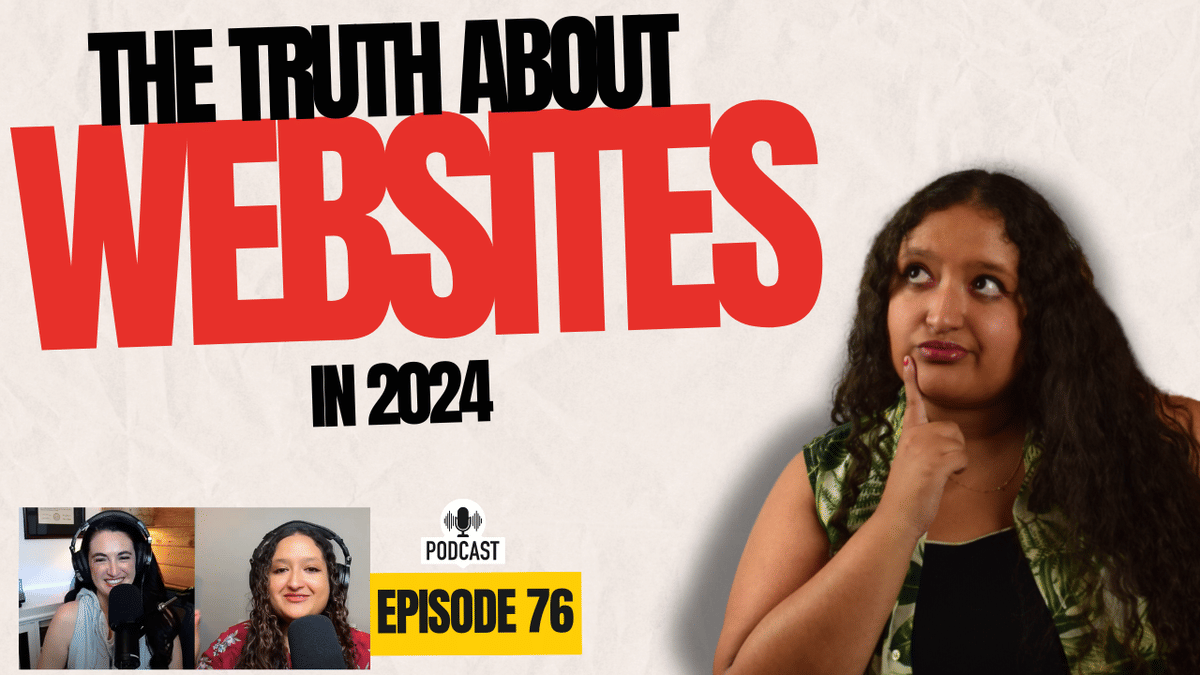
Websites are still relevant in 2024 - and as a small business owner you NEED one. A website will give you the opportunity to be in full control of how you communicate with and interact with your customers. Relying on other platforms, for example social media, will leave you at a disadvantage. At the end of the day, you do not control these other platforms. The only thing you have 100% control over is the website that you build or that someone builds for you.
According to research, 27% of small businesses do not have a website. That is a little more than 1 in 4 small business owners! Let’s look at this from the consumer’s perspective. If I am looking into a small business and I can’t find their website, how do I know that they’re a legit business?
What typically happens is a small business is relying on a Google Business Profile. While we do recommend taking advantage of your Google Business Profile - that should not be what you rely on.
(Claiming your Google business profile means that you will show up on Google Maps. Make sure you also claim your Apple Maps listing because these are two very different things. If you want to show up for people with iPhones, you need to be on Apple Maps.)
A website is not only important when it comes to legitimizing your business, but it also builds trust, and increases your visibility. Everyone uses Google. You want your website to appear when people search for related information. This is why making sure your website is SEO optimized is important.
A small business website is also helpful when it comes to tracking your data. Data will always help you find out what is working and what is not when it comes to your small business’s website. This is a great opportunity to better understand your consumers.
Data includes: who are your visitors, what web pages are they visiting and staying on the most. You can track conversions rates, track visitors, and it can help you collect leads.
Another reason you should have a website: it is a place where you can display your products and sell more. This also goes directly hand in hand with search engine optimization (SEO).
Let’s say you sell candles on social media. That’s fine, but once you have a website then you can display ALL of your products and give customers the opportunity to buy them on YOUR website. For one, that’s self standing. It can also keeping doing the work even when you’re not actively promoting on there. Each one of your listed products gives you an opportunity to actually provide more information via product description. This will give you a boost in the search engine optimization world.
A website also gives you an opportunity to tell your story. If you want to tell your story on an Instagram reel, then you have 90 seconds. On your own platform you can build your story the way you want - whether you do that in a 10 minute video or just a few paragraphs on a landing page.
Building a website does not mean you have to hire a web developer. You absolutely can if you want to. If you want to save money and do it yourself, there are many platforms with premade templates for you to use, like Squarespace. You do not need to be a fancy web developer to build your own website. If you want to work with a web developer, just make sure you have fully vetted the business. There is no way you can get an intricate website for $300. Web development can cost in the thousands. It depends on the features you want and the amount of pages needed.
Shop around for the web developer that will work best with you and is the right price. You will also want clear communication upfront.
When building your website - remember that organization is important. Consider drawing out a map of how you plan to lay out your website.
You also need to take into consideration where you are in your small business story. A website for a small business just starting out looks vastly different from a veteran small business.
It is important to evaluate your time as well as your budget when deciding if you want to outsource or build a website for your small business yourself. Just know what you need, what works best for you, and what your budget allows.
When it comes to building your website you need: consistent branding, to optimize for search engine optimization (SEO), to be optimized for mobile, and to have fast load speed*. It is also important to make your website easy to navigate. Do not bury your information deep within your website, because no one will go looking for it. According to statistics, people are only willing to click on a website 2-3 times to find the information they need or they will give up. This best way to combat this issue is to physically draw a map of your website and the flow you want it to have. Visualizing will help you decide if there are too many categories and/or subcategories.
*If you are unsure of your website’s speed, you can use this FREE tool to find out. Simply go to developers.google.com/speed.
There is still a cost that comes with building your own website. It's going be significantly less than if you outsource your website design, but you still are going to be incurring a cost. For one, you will need a domain. You can get a free domain through wp.com. But if you want to legitimize your business and you want something like TheSeasonedMarketer.com or [insert your business name here].com, then you need to go and purchase it.
Secondly, you're gonna need a host platform.
We use WordPress to build the website, but we do it through Bluehost. Bluehost is what provides us the host platform is what provides me the security.
I can also do everything I need to for the design and stuff, in WordPress through that. The other thing is the template. There are some free templates out there, but some of the really good ones are going to cost you maybe $67 or around that.
A plug in sometimes will cost you money. For example, let's say that you want to be able to have some type of search function on your back end for staff members. You would include plugins, which will cost you money.
Please don't skimp out on security either. Keep your website secure. You want your customers to feel confident that their information isn't going to get leaked or anything. If your website starts with https, and then you have “://”, it's secure. That is a SSL certificate.
Social Media Is Changing FAST - 4 Updates You Can't Afford to Ignore in 2026
Keeping up with social media updates and changes can feel like a full-time job, which is why we do the research for our S.O.B. Community members every week! In this episode, we're sharing four important social media updates from the past few months that we've already discussed with our community mem...
7 Marketing Things Small Business Owners Waste Money On
Are you spending money on marketing that isn't actually helping your small business grow? Just because something is popular, expensive, or easy to do doesn't mean it's the right investment for YOUR business. In this episode of the S.O.B. Marketing Podcast, we're sharing 7 marketing things small busi...
Do You REALLY Have to Do Video Marketing in 2026?
Small business owners are always being told they NEED to be showing up on video but is it true? In this episode of the S.O.B. Marketing Podcast, we have a candid discussion about how your smalll business can benefit from video marketing, as video is becoming increasingly important across social medi...
Do You Really Want to Be the Face of Your Business?
If you’ve ever felt the pressure to be the face of your business, constantly creating content, sharing your life, and putting yourself out there, this episode is for you. We dig into the personal brand vs. logo-led brand debate and the bigger question behind it: What kind of business do you actually...
Is Your Business Showing Up on ChatGPT or other AI Chatbots? Here's How to Find Out
Even if you personally aren't a fan of AI Chatbots like ChatGPT, Claude, or Grok - you WANT your small business to get recommended in their search results because that can lead to more sales. But how do you even start to measure your AI "visibility"? In this episode, we share a four-lens framework f...
Google Search Console Is Changing: What Small Business Owners Need to Know in 2026
Google Search Console just got a lot more interesting for small business owners. Google is giving businesses new insight into how their content shows up across search and that includes the growing connection between your website, social media content, and the way people discover you in search. In th...
Why Should Anyone Shop with You on Small Business Saturday?
Small Business Saturday is a fabulous opportunity to increase your sales, but it's not enough to ask people to shop with you just because you're a small business! In this episode, we share questions you can ask to help you identify what makes your product, service, or experience different and how yo...
Small Business Saturday is Coming - Are You Ready?
There is MONEY to be made on Small Business Saturday! Estimates are that around 62.7 million people shop in-store and about 63 million people shop online. While this episode was originally shared in 2023, the strategies we share to increase sales during this small business specific holiday are more ...
What To Do When People Ask Your Business for Free Stuff
Small business owners get asked for free donations all the time from non-profits, event-organizers, influencers, and even family and friends - but when (if ever) does it make sense to actually say YES? In this episode, we discuss how to approach requests for free stuff from a marketing perspective a...